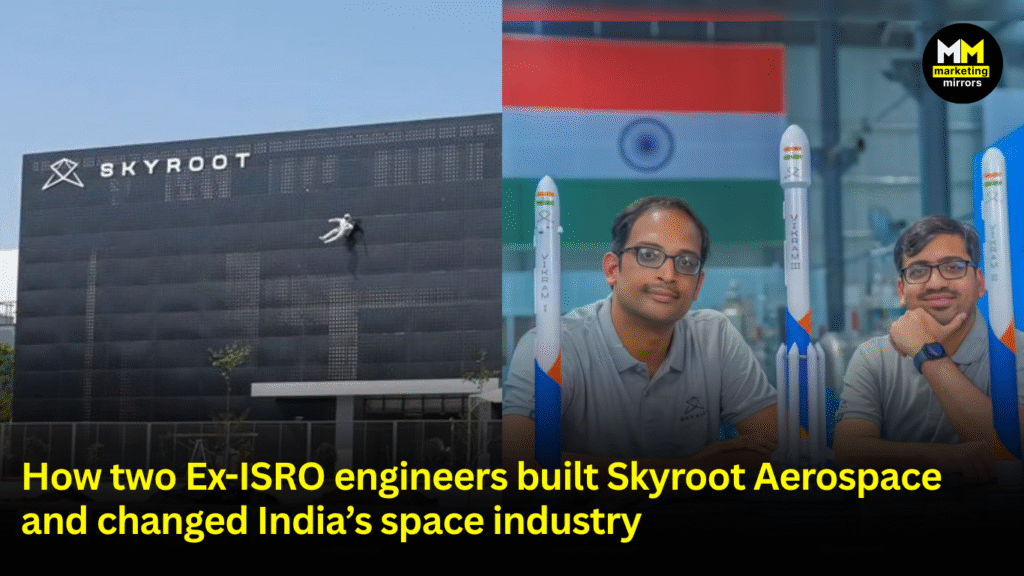
India’s space industry has entered a new era, and Skyroot Aerospace is leading the transformation. Founded by two former ISRO scientists, the Hyderabad-based startup has achieved what once seemed impossible by developing and launching India’s first privately built orbital rocket.
Who Founded Skyroot Aerospace?
Skyroot Aerospace was founded in 2018 by Pawan Kumar Chandana and Naga Bharath Daka, two engineers who previously worked at the Indian Space Research Organisation (ISRO).
Both founders spent years contributing to India’s launch vehicle programs before deciding to build something of their own.
Pawan Kumar Chandana
Pawan Kumar Chandana serves as the CEO and Co-founder of Skyroot Aerospace.
An alumnus of IIT Kharagpur, he graduated with a dual degree in Mechanical Engineering before joining ISRO in 2012. During his tenure, he worked on India’s prestigious GSLV Mk-III (now LVM3) launch vehicle at the Vikram Sarabhai Space Centre.
Interestingly, Pawan has publicly shared that he scored only 51 marks in Mathematics during school and even failed one subject. His story has inspired countless students by proving that determination matters more than academic scores.
Naga Bharath Daka
Naga Bharath Daka is the COO and Co-founder of Skyroot Aerospace.
An alumnus of IIT Madras, he specialized in electronics and microelectronics before joining ISRO, where he worked on launch vehicle electronics and mission systems.
Together, Chandana’s expertise in rocket propulsion and Daka’s experience in avionics created the perfect combination for building a world-class aerospace company.
The Birth of Skyroot Aerospace
Skyroot Aerospace was established in Hyderabad in 2018 with a small team of engineers and a bold vision.
At the time, India’s private space ecosystem was still in its infancy. There were very few private companies building rockets, and investors were cautious about funding capital-intensive space startups.
Despite these challenges, the founders remained committed to their mission of making space more accessible and affordable.
Early Challenges
Like every deep-tech startup, Skyroot faced significant hurdles during its early years.
Raising Capital
Unlike software startups, aerospace companies require years of research and millions of dollars before generating revenue.
Investors initially hesitated because rocket development involves:
- Long development cycles
- Expensive testing
- High technological risks
- Delayed returns
Convincing investors to support a private rocket company was one of the company’s biggest achievements.
Regulatory Environment
Before India’s space reforms, private companies had limited opportunities to build and launch rockets.
The establishment of IN-SPACe and the government’s decision to open the space sector created new opportunities for startups like Skyroot Aerospace.
These reforms accelerated innovation across India’s private space industry.
Building Advanced Technology
Designing rockets requires expertise in propulsion systems, avionics, software, materials engineering, and manufacturing.
Skyroot invested heavily in research and development, including advanced manufacturing techniques such as 3D-printed rocket engines and carbon composite structures.
Major Milestones of Skyroot Aerospace
2018 – Company Founded
Skyroot Aerospace was officially founded in Hyderabad with the goal of building launch vehicles for small satellites.
2020 – Engine Testing Success
The company successfully completed static tests of its rocket engines.
It also developed several indigenous technologies, including:
- Raman liquid rocket engines
- Kalam solid rocket motors
- Advanced 3D-printed propulsion components
These achievements established Skyroot as one of India’s most promising space startups.
2022 – Launch of Vikram-S
Skyroot created history by launching Vikram-S under Mission Prarambh.
The launch marked India’s first privately developed rocket.
Although Vikram-S was a suborbital mission, it demonstrated that Indian startups could successfully design, manufacture, and launch rockets.
This achievement significantly boosted investor confidence in India’s private space sector.
2026 – Historic Vikram-1 Launch
The biggest milestone came in 2026 when Skyroot successfully launched Vikram-1 under Mission Aagaman.
The mission achieved orbit successfully, making it:
- India’s first privately developed orbital rocket
- A landmark achievement for Indian space technology
- A major step toward commercial satellite launches
The success positioned India among a select group of nations capable of private orbital launches.
Understanding the Vikram Rocket Family
Skyroot named its rockets after Dr. Vikram Sarabhai, the father of India’s space program.
Vikram-S
- Technology demonstrator
- Suborbital rocket
- Used to validate critical technologies
Vikram-1
- Orbital launch vehicle
- Designed for commercial satellite launches
- Built using lightweight carbon composite structures
- Optimized for small satellite deployment
Future versions such as Vikram-II are expected to offer higher payload capacities and increased launch frequency.
Skyroot Aerospace Business Model
Unlike traditional manufacturing companies, Skyroot does not primarily sell rockets.
Instead, it offers launch services.
Its customers include:
- Satellite companies
- Earth observation firms
- Universities
- Research organizations
- Defence organizations
- International commercial satellite operators
As demand for small satellites continues to grow, launch services are becoming an increasingly valuable business.
Revenue Sources
Skyroot Aerospace generates revenue through multiple streams, including:
- Commercial satellite launches
- Launch integration services
- Mission planning
- Space systems engineering
- Technology partnerships
With more launches planned in the coming years, the company’s revenue is expected to grow significantly.
Funding Journey
Building rockets requires substantial financial backing.
Skyroot has successfully attracted investments from several renowned investors, including:
- Sherpalo Ventures
- GIC Singapore
- BlackRock
- Arkam Ventures
- Greenko Group founders
- Playbook Partners
- Family offices and strategic investors
These investments have enabled the company to expand manufacturing capabilities, strengthen research, and accelerate commercial launches.
India’s First Space-Tech Unicorn
In 2026, Skyroot Aerospace achieved another historic milestone by becoming India’s first space-tech unicorn after raising approximately $60 million in fresh funding.
The company crossed a valuation of over $1 billion, highlighting growing investor confidence in India’s private space ecosystem.
About Marketing Mirrors
Marketing Mirrors is a fast-growing digital storytelling platform that showcases real-life success stories of Indian entrepreneurs, creators, and innovators. Through their content, they highlight brands and individuals who’ve turned ideas into impact — inspiring thousands to chase their dreams