Starting a coffee business usually sounds expensive. Commercial espresso machines, café interiors, rent, staff and marketing can quickly push the investment into several lakhs.
But Delhi-based coffee brand Kofi Kafi took a very different route.
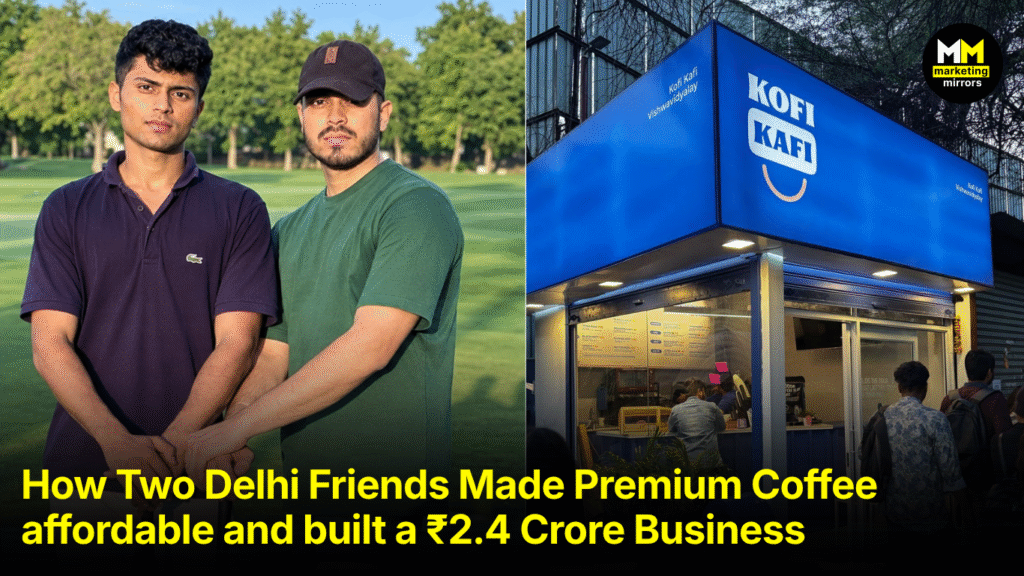
Founded by friends Vaibhav Arora and Vansh Mor in 2023, Kofi Kafi started with a customised roadside coffee cart in Rohini, Delhi, and an initial investment of just ₹3 lakh.
What began as a small experiment aimed at making good coffee more affordable has since grown into a multi-outlet coffee business serving customers across Delhi NCR.
Who Founded Kofi Kafi?
Kofi Kafi was founded by Delhi-based entrepreneurs Vaibhav Arora and Vansh Mor.
The two founders came from a college and youth-oriented environment and noticed an interesting problem.
Coffee was becoming increasingly popular among young Indians, particularly students and young professionals, but premium café coffee could be expensive for everyday consumption.
The founders themselves were regular café customers and understood the problem from personal experience.
Instead of trying to immediately build a traditional café with expensive interiors and high operating costs, they decided to experiment with a much smaller format.
That experiment became Kofi Kafi.
How Kofi Kafi Started With ₹3 Lakh
Kofi Kafi officially began on June 11, 2023, with a customised roadside coffee cart in Rohini, Delhi.
The founders invested around ₹3 lakh of their own money to start the business.
At the beginning, they faced an obvious challenge: professional espresso machines were expensive.
Rather than spending most of their capital on equipment, the founders used traditional coffee machines and premium instant coffee during the early stage.
This allowed them to test whether customers would actually pay for their product before making a much larger investment.
Their initial coffee prices were reportedly between ₹50 and ₹85.
The strategy was simple:
Affordable coffee + high-footfall location + low operating costs.
And it worked.
Kofi Kafi’s First-Month Sales
The response to the roadside cart was reportedly much stronger than the founders expected.
During its first month, Kofi Kafi generated around ₹3–3.5 lakh in sales.
This was significant because the founders had initially invested approximately ₹3 lakh into the business.
The early sales gave them confidence that there was demand for affordable coffee among students and young consumers.
Instead of immediately opening multiple expensive cafés, they continued experimenting with the format and gradually improved the business.
From Roadside Cart to a Permanent Coffee Outlet
After validating the concept, Kofi Kafi opened its first permanent outlet in Kamla Nagar in November 2023.
The founders invested approximately ₹2 lakh in semi-automatic commercial espresso machines.
This allowed the business to move toward freshly brewed, bean-to-cup coffee.
The transition was important because the company was no longer simply testing whether people wanted affordable coffee. It was beginning to build a repeatable coffee business.
The founders also developed a distinctive visual identity using bold colours, graffiti-inspired elements and street culture.
This helped Kofi Kafi stand apart from traditional cafés.
Kofi Kafi’s Business Model
One of the most interesting parts of Kofi Kafi’s growth is its business model.
Instead of following the traditional café model, where businesses spend heavily on interiors, seating and large locations, Kofi Kafi focuses on compact grab-and-go outlets.
Many of its outlets are relatively small, with limited or no seating.
This model can reduce expenses such as:
– High commercial rent
– Large interior investments
– Extensive furniture costs
– Large front-of-house teams
– Maintenance expenses
The focus is on serving coffee quickly rather than making customers spend hours inside a café.
This fits particularly well with students, commuters and young professionals looking for an affordable coffee during college, work or travel.
Why Kofi Kafi Keeps Its Outlets Small
A large café requires a large amount of space.
More space generally means higher rent, more furniture, more employees and higher maintenance costs.
Kofi Kafi took the opposite approach.
Its compact outlets are designed around takeaway and quick consumption.
The model allows the company to focus more heavily on:
– Product
– Location
– Speed
– Affordability
– Customer frequency
– Brand identity
This is particularly useful in dense urban areas where customers may not necessarily want a large café experience every time they buy coffee.
How Much Revenue Does Kofi Kafi Generate?
According to NDTV Food’s July 2026 report, Kofi Kafi was generating approximately ₹20 lakh in monthly revenue.
If that monthly revenue continues consistently, it represents an annualized revenue run rate of approximately:
₹20 lakh × 12 = ₹2.4 crore
It is important to understand that ₹2.4 crore is an annualized estimate based on the reported monthly run rate. It should not automatically be interpreted as audited annual revenue.
The same report stated that Kofi Kafi had five outlets operating across Delhi, with another outlet under development at the time of reporting.
Kofi Kafi’s Current Scale
As reported in July 2026, Kofi Kafi had:
– Five operating outlets
– Around 1,000–1,500 daily customers
– More than 5 lakh cups sold since launch
– Approximately ₹20 lakh monthly revenue
– Around 20–22 ground staff
– A four-member administrative team
– Additional expansion underway
The company has built its presence around Delhi and continues to focus on locations with strong student, commuter and young-professional populations.
Where Are Kofi Kafi Outlets Located?
The business has expanded across several Delhi locations.
Reported locations include:
– DC Chowk Market, Rohini
– Rohini Sector 16
– Vishwavidyalaya Metro Station
– Ram Lal Anand College Campus
– Vasant Vihar
A Punjabi Bagh outlet was also reported to be under development.
Kofi Kafi’s official website describes the brand as operating across Delhi NCR and positions it as a youth-focused coffee movement.
What Makes Kofi Kafi Different?
The biggest differentiator is not simply the coffee.
It is the combination of affordability, accessibility and branding.
Traditional premium cafés often sell an experience built around interiors, seating and ambience.
Kofi Kafi is trying to build a different experience.
Its positioning revolves around:
Good coffee, affordable prices, youth culture, fast service.
The company describes itself as a youth-oriented coffee brand and uses street art, graffiti, music and pop-up collaborations to strengthen that identity.
This makes the brand feel less like a conventional café chain and more like a youth lifestyle brand.
Kofi Kafi’s Marketing Strategy
Kofi Kafi’s marketing approach is closely connected to its target audience.
Instead of presenting itself as a traditional premium café, the brand has built a strong youth-focused personality.
Its branding incorporates:
– Graffiti
– Street culture
– Music
– Youth events
– Pop-up activities
– Social media
– Creator culture
The company is essentially selling a lifestyle along with its coffee.
This is especially useful for younger consumers who often discover food and beverage brands through Instagram, short-form videos and word of mouth.
About Marketing Mirrors
Marketing Mirrors is a fast-growing digital storytelling platform that showcases real-life success stories of Indian entrepreneurs, creators, and innovators. Through their content, they highlight brands and individuals who’ve turned ideas into impact — inspiring thousands to chase their dreams.