How Mamaearth Started
Mamaearth began with a problem that many new businesses are built around: the founders couldn’t find a product they actually wanted to buy.
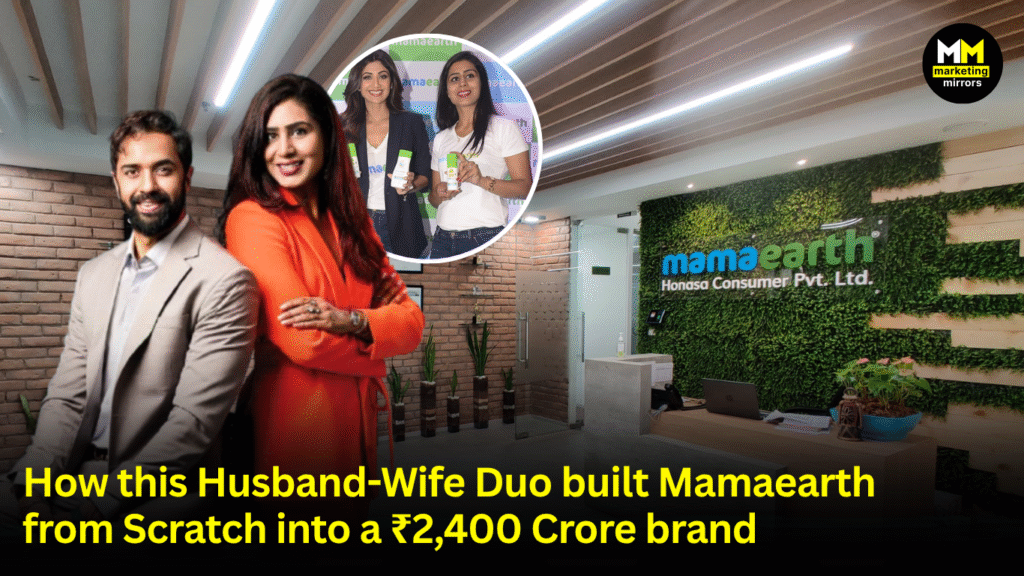
In 2016, Ghazal Alagh and Varun Alagh became parents to their first child. They were looking for safe and toxin-free baby-care products but found that the Indian market did not offer enough options that met their expectations.
Instead of continuing to import products from abroad, they decided to build their own.
That idea became Mamaearth, which launched in 2016 as a baby-care brand.
Today, Mamaearth is the flagship brand of Honasa Consumer Limited, a digital-first beauty and personal-care company that has expanded into multiple brands and categories.
Who Are Ghazal and Varun Alagh?
Varun Alagh
Before becoming an entrepreneur, Varun Alagh worked in the consumer goods and marketing industry, gaining experience with companies including Hindustan Unilever, Coca-Cola and Diageo.
That experience became valuable when building Mamaearth because the company was not simply creating products. It was trying to build a consumer brand and eventually compete with established FMCG companies.
Today, Varun Alagh is the Co-founder, Chairman and CEO of Honasa Consumer. The company says his approach combines consumer-focused innovation, digital-first distribution and data-driven marketing.
Ghazal Alagh
Ghazal Alagh came from a different background, with experience in technology, art, design and consumer-focused work.
At Mamaearth, she became closely involved in product innovation, consumer understanding and community building.
The combination of their backgrounds became one of the company’s strengths:
Varun brought FMCG and business experience, while Ghazal brought product, consumer and design perspectives.
Mamaearth Started With Just Six Products
The company did not launch with hundreds of SKUs.
It began with only six baby-care products.
The initial focus was narrow:
Baby products for parents looking for safer and toxin-free alternatives.
This gave Mamaearth a clear target customer and a simple brand proposition.
Instead of trying to compete with every beauty company in India, the founders initially focused on one specific problem.
That helped the company learn from its first customers before expanding into larger categories.
Why Mamaearth Was Different
Mamaearth entered the market at a time when India’s e-commerce and social-media ecosystems were growing rapidly.
Traditional FMCG companies generally depended heavily on:
Manufacturers → Distributors → Retailers → Customers
Mamaearth could use a more direct model:
Manufacturer → Digital marketing → E-commerce → Customer
This allowed the company to reach consumers without immediately building a huge physical retail network.
Its early digital-first strategy also allowed the brand to collect customer feedback and understand buying behaviour more directly.
Mamaearth’s Business Model
Mamaearth’s business model can broadly be described as a digital-first, consumer-focused beauty and personal-care model.
The company generates revenue by selling its products across multiple categories and channels.
1. Direct-to-Consumer
Mamaearth initially built its business around online sales.
Its own digital channels allowed the company to communicate directly with customers, promote products and collect consumer insights.
2. E-commerce
Online marketplaces played an important role in the company’s early growth.
This helped Mamaearth reach customers across India without requiring a large physical store network from day one.
3. Offline Retail
As the brand grew, it expanded beyond digital channels.
Honasa now describes its business as omnichannel, with a presence across more than 750 districts.
The company now operates across:
- General trade
- Modern trade
- E-commerce
- Direct digital channels
Recent company commentary says growth is now coming from all three major channels: general trade, modern trade and e-commerce.
4. House of Brands
The biggest evolution in the business model was moving beyond Mamaearth itself.
Honasa began developing and acquiring multiple beauty and personal-care brands.
Instead of forcing one brand to serve every consumer, each brand could target a specific customer need.
The Marketing Strategy Behind Mamaearth
Products alone did not make Mamaearth successful.
Its marketing strategy was equally important.
The brand built a strong presence through:
- Social media
- Influencer marketing
- Content marketing
- Parenting communities
- Celebrity endorsements
- Digital advertising
- Customer reviews
- E-commerce
The founders understood that beauty and personal-care products are highly influenced by trust.
Consumers want to know:
Does it work?
What ingredients does it contain?
Has someone else tried it?
Can I trust the brand?
Influencers and user-generated content helped answer those questions at scale.
The Goodness Positioning
Mamaearth positioned itself around the idea of safer, conscious personal care.
The company says Mamaearth became Asia’s first brand with Made Safe-certified products. It also describes the brand as cruelty-free and plastic-positive.
This positioning helped differentiate Mamaearth in a market where consumers were becoming increasingly interested in:
- Natural ingredients
- Product safety
- Transparency
- Sustainable choices
- Clean beauty
The company wasn’t simply selling shampoo or lotion.
It was selling a belief about how personal-care products should be made.
From Mamaearth to Honasa Consumer
This is where the business became much bigger.
Mamaearth is a brand.
Honasa Consumer is the company behind it.
Honasa has developed and acquired multiple beauty and personal-care brands.
Its current portfolio includes:
- Mamaearth
- The Derma Co.
- Aqualogica
- Luminéve
- Staze
- BBlunt
- Dr. Sheth’s
- Reginald Men
Honasa currently describes itself as a digital-first house of brands with eight brands serving different beauty and personal-care needs.
This strategy allows each brand to have a distinct identity.
For example:
Mamaearth: natural and everyday personal care
The Derma Co.: science-backed skincare and active ingredients
BBlunt: haircare and salon-style products
Dr. Sheth’s: dermatologist-formulated skincare
The company therefore doesn’t depend on one brand to capture the entire beauty market.
Why Honasa Built Multiple Brands
Imagine trying to make one shampoo brand appeal simultaneously to:
- A new mother
- A teenager with acne
- A man looking for grooming products
- Someone interested in premium skincare
- A consumer looking for hair styling products
The messaging becomes a marketing nightmare.
Instead, Honasa created different brands with different identities.
This is the logic behind a house-of-brands strategy.
One company.
Multiple brands.
Different customer segments.
Different product propositions.
Revenue and Financial Growth
Honasa Consumer is now a publicly listed company, so its financial performance is available through regulatory filings and investor disclosures.
For FY2025-26, Honasa reported approximately:
₹200.2 crore consolidated net profit, compared with ₹72.7 crore in the previous year. Its Q4 FY26 net profit was ₹69.4 crore, up 178% year over year.
The company’s latest quarter shows continued momentum.
For Q1 FY27, Honasa reported:
- Revenue from operations: ₹755.9 crore
- Net profit: ₹90.4 crore
- Revenue growth: 27% YoY
- Net profit growth: 119% YoY
- Operating profit: approximately ₹110.2 crore
The company said the quarter delivered its highest-ever quarterly revenue and profit.
This is important because the company had previously faced pressure around growth and profitability.
The latest numbers indicate a significant improvement in financial performance.
About Marketing Mirrors
Marketing Mirrors is a fast-growing digital storytelling platform that showcases real-life success stories of Indian entrepreneurs, creators, and innovators. Through their content, they highlight brands and individuals who’ve turned ideas into impact — inspiring thousands to chase their dreams