The Story of FitFeast
What if a personal fitness struggle could become the foundation of a business?
That is the story behind FitFeast, the Indian protein-snacking brand founded by Aditya Poddar.
Aditya’s journey started with his own struggle to lose weight and build a healthier lifestyle. While searching for better nutrition options, he noticed a problem in the market: protein products were often expensive, lacked taste, or were difficult to consume every day.
Instead of accepting the problem, he decided to build a company around it.
Today, FitFeast has grown from a bootstrapped startup into a D2C protein brand with products ranging from protein chips and peanut butter to protein bars and shakes.
Who Is Aditya Poddar?
Aditya Poddar is a Delhi-based entrepreneur and the founder of FitFeast.
He studied Computer Science at Jaypee Institute of Information Technology, Noida, and later worked in an analytics role at AXA.
But entrepreneurship had already caught his attention.
During college, Aditya experimented with an early startup idea connecting fitness trainers with customers. Although that business did not take off, the experience gave him an early understanding of entrepreneurship.
His real business journey would begin after his own transformation.
The Fitness Journey That Started It All
Aditya’s interest in fitness began during college.
At one point, he weighed around 90 kg. He started going to the gym and experimented with different diets and fitness routines.
Over time, he managed to lose approximately 20 kg.
But the experience taught him something more important than losing weight.
He realized that maintaining a healthy lifestyle requires consistency, particularly when it comes to diet.
And that’s where he noticed a gap.
Many protein products available in the market were not particularly enjoyable to eat. Some had an unpleasant taste or texture, while others were expensive for regular consumption.
Aditya saw an opportunity to create something different:
Protein products that people would actually enjoy eating.
How FitFeast Started
Aditya began exploring the food and FMCG industry while still working in corporate analytics.
He visited manufacturers across India and started learning how the food business actually worked.
Terms such as CAC, ROAS, distributors and super-stockists were unfamiliar to him at first.
But he learned along the way.
In 2021, he began developing what would eventually become FitFeast.
The first product was protein chips.
The idea was simple but unusual at the time:
Why shouldn’t a popular snack like chips also provide meaningful protein?
Building the First Product Wasn’t Easy
Being a young founder made the early stages particularly difficult.
Many manufacturers were hesitant to take Aditya seriously.
He had to deal with:
- Manufacturing challenges
- Minimum order quantities
- Failed product samples
- Product development
- Packaging
- Marketing
- Inventory
- Logistics
- Customer acquisition
FitFeast spent months experimenting with formulations before settling on products that matched its desired balance of taste and nutrition.
The company was initially completely bootstrapped, meaning Aditya had to build the business without relying on major institutional funding.
The First Orders Were Far From Impressive
FitFeast’s first product launched in December 2021.
The first day brought around 15 orders.
There was just one tiny problem.
Most of those orders came from friends and family.
For a founder, this is the startup equivalent of throwing a party and discovering the entire guest list is your relatives.
The first month was extremely slow.
Instead of giving up, Aditya started learning digital marketing and began experimenting with online advertising and customer acquisition.
Gradually, strangers began purchasing the products.
That was the first real validation that FitFeast could become a business.
From Protein Chips to a Full Product Range
FitFeast didn’t remain a one-product company.
The brand expanded into several protein-focused food categories.
Its current portfolio includes:
Protein Chips
A high-protein alternative to conventional snacking, designed to combine crunch with added protein.
Protein Peanut Butter
One of the company’s major product categories, including flavours such as White Chocolate and Mango.
Protein Bars
Snack bars designed to combine indulgent flavours with higher protein content.
Protein Shakes
Single-serve protein shake formats, including flavours such as Malai Kulfi and Coffee.
Protein Cookies
Another snack format aimed at making protein consumption more convenient.
The underlying strategy remains consistent:
Make protein feel like a tasty everyday food instead of a boring fitness obligation.
FitFeast’s Business Model
FitFeast follows a D2C, or direct-to-consumer, business model.
The company sells products directly to customers through digital channels rather than depending entirely on traditional retail distribution.
Its sales channels include:
- FitFeast’s own website
- Online marketplaces
- Quick-commerce platforms
- Other digital distribution channels
This model gives the company direct access to customer data and feedback.
It can understand which flavours customers prefer, which products are reordered and which offers generate the most sales.
The company has also focused heavily on reaching consumers beyond India’s biggest metropolitan cities.
Why Tier II and Tier III Cities Are Important
One of the most interesting parts of the FitFeast business is its customer base.
Recent reports indicate that around 65–70% of the company’s business comes from non-metro cities.
This is important because India’s health and fitness market is expanding beyond major cities.
Consumers in smaller cities are increasingly spending on:
- Fitness
- Sports nutrition
- Healthy snacks
- Protein products
- Wellness
FitFeast’s positioning around relatively accessible protein products allows it to target this growing market.
The company has reportedly reached customers across 20,000+ pin codes.
The Shark Tank India Journey
FitFeast’s journey to Shark Tank India was not immediate.
The company reportedly applied multiple times before finally appearing on the show.
When Aditya eventually entered the Tank, he presented FitFeast as a protein-snacking company focused on making nutrition more enjoyable and accessible.
The pitch attracted attention from the Sharks.
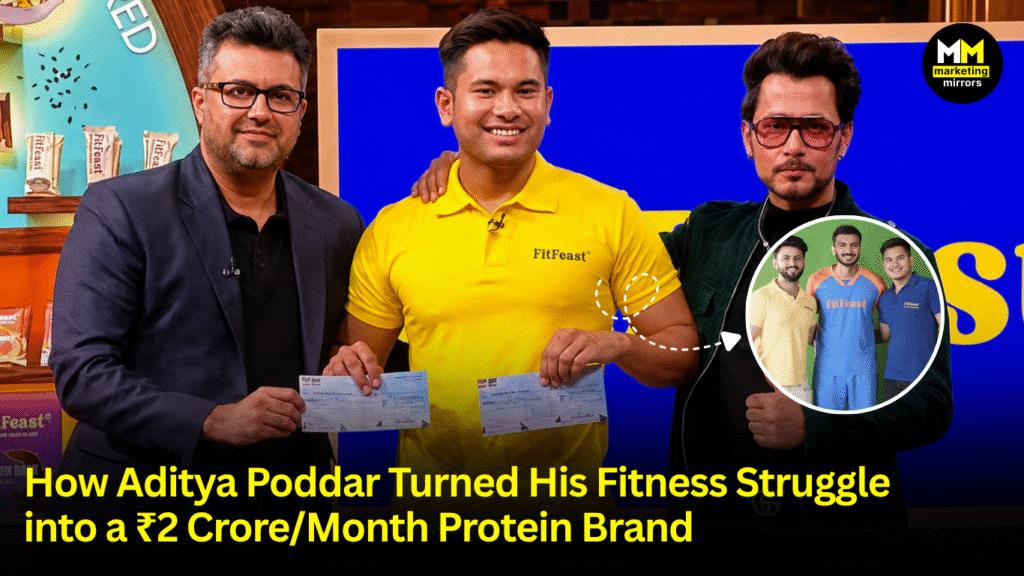
FitFeast eventually secured a deal of approximately ₹1 crore for around 18% equity from Anupam Mittal and Viraj Bahl.
The investment provided capital, but the television exposure was arguably just as valuable.
Millions of viewers were introduced to the brand.
FitFeast Attracted Further Investment
The Shark Tank appearance was followed by another major milestone.
In 2025, FitFeast raised approximately ₹5.5 crore in seed funding, led by Inflection Point Ventures.
The round also included notable investors and strategic participation from former Australian cricketer Shane Watson and Indian cricketer Axar Patel.
Their involvement gave the brand additional visibility in India’s massive sports and fitness audience.
For a young protein brand, having recognizable sports personalities associated with the business can also strengthen consumer trust and brand positioning.
FitFeast Revenue Growth
FitFeast has reported strong growth as it expanded its product range and distribution.
Recent reports put the company’s annual net revenue at approximately:
| Financial Year | Reported Revenue |
|---|---|
| FY2024 | ₹1.4 crore |
| FY2025 | ₹2.4 crore |
| FY2026 | ₹7 crore |
More recently, the company has reported monthly revenue of more than ₹2 crore.
The company is also targeting approximately ₹100 crore in annual revenue over the next two years.
The monthly figure represents the company’s current reported run rate, so it should not automatically be treated as audited annual revenue.
Product Testing and Transparency
For a protein brand, trust is extremely important.
FitFeast says its products undergo third-party testing at NABL-accredited laboratories and that laboratory reports are made publicly available.
The company says testing covers areas including protein content, amino-acid profiles, macronutrients and various safety parameters.
This approach is intended to give customers greater confidence in the nutritional claims made on its products.
About Marketing Mirrors
Marketing Mirrors is a fast-growing digital storytelling platform that showcases real-life success stories of Indian entrepreneurs, creators, and innovators. Through their content, they highlight brands and individuals who’ve turned ideas into impact — inspiring thousands to chase their dreams