What started as a quick-service restaurant selling wraps eventually evolved into a global food technology business operating multiple restaurant brands through shared kitchen infrastructure.
Behind this transformation were two entrepreneurs, Jaydeep Barman and Kallol Banerjee, who challenged a fundamental assumption of the restaurant industry: Does every food brand really need its own physical restaurant?
Their answer helped transform Faasos into Rebel Foods, a company that achieved a valuation of approximately ₹11,700 crore in 2021.
Here is how a simple observation about customer behaviour led to one of India’s most interesting food business models.
The Beginning: How Faasos Started in 2011
The story of Rebel Foods began with Faasos, a quick-service restaurant business founded by Jaydeep Barman and Kallol Banerjee in 2011.
The concept was straightforward: offer convenient, affordable and delicious wraps to customers looking for quick meals.
Like traditional restaurant businesses, Faasos initially relied on physical outlets to attract customers and generate sales.
However, expanding a restaurant chain was expensive.
Every new location required considerable investment in commercial space, interiors, equipment, employees and daily operations.
Premium locations attracted higher rents, while dining areas added expenses that were difficult to eliminate.
As Faasos expanded, the founders began questioning whether traditional restaurant infrastructure was necessary for every order.
That question eventually changed the direction of their business.
The Discovery That Changed Their Business
Around 2015, the founders noticed an interesting pattern in customer behaviour.
A significant portion of Faasos customers were ordering food for delivery rather than visiting its restaurants.
Reports suggest that approximately 70% of customers had never visited a physical Faasos outlet.
This observation revealed an opportunity.
If customers were primarily interested in receiving food at their homes or offices, why should the company continue investing heavily in expensive dining spaces?
The founders realised that the business could operate from delivery-focused kitchens located in relatively affordable commercial areas.
Instead of spending money on premium storefronts, the company could direct more resources towards food preparation, delivery operations, technology and customer experience.
This marked the beginning of Faasos’ transformation into a cloud kitchen business.
From Faasos to Rebel Foods: A New Business Model
A cloud kitchen, sometimes called a ghost kitchen, is a commercial kitchen designed primarily to prepare food for delivery.
Unlike traditional restaurants, cloud kitchens generally do not require dining areas or expensive customer-facing interiors.
However, Rebel Foods took this concept further.
The company realised that a single kitchen could prepare meals for multiple food brands.
For example, one kitchen could potentially fulfil orders for wraps, biryani, pizza and desserts, with each category operating under a different brand identity.
This approach allowed the company to expand its product portfolio without building a completely separate physical restaurant for every brand.
In 2016, the company accelerated its multi-brand strategy by introducing several food concepts.
Faasos eventually evolved into Rebel Foods, reflecting its ambition to build a larger food technology platform rather than remain a single restaurant chain.
The Multi-Brand Strategy Behind Rebel Foods
One of Rebel Foods’ biggest strengths is its ability to operate several food brands using shared infrastructure.
Instead of expecting one restaurant brand to satisfy every customer’s preferences, the company developed specialised brands targeting different food categories.
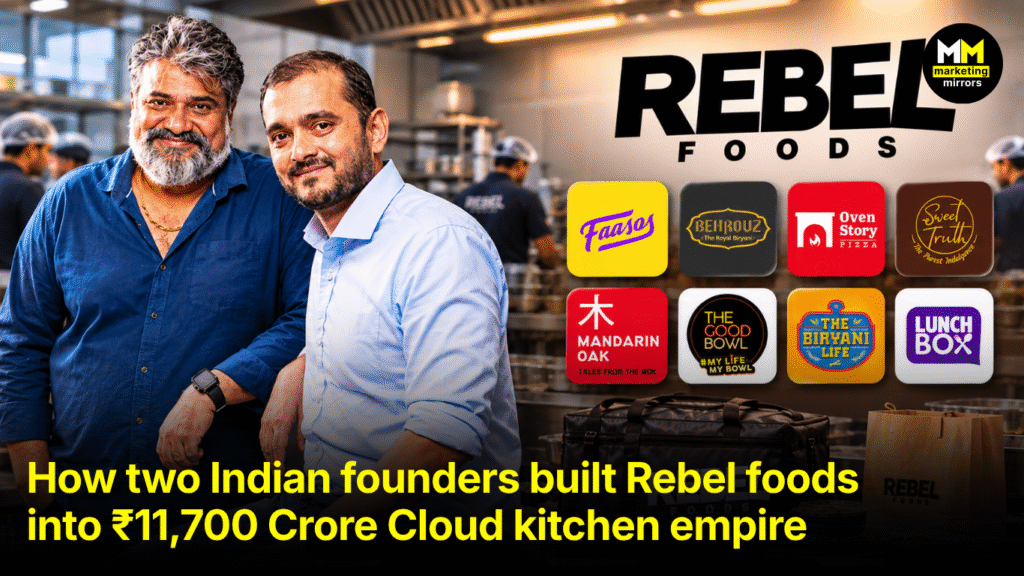
Some of its popular brands include:
- Faasos: Known for wraps and rolls.
- Behrouz Biryani: Focused on premium biryani offerings.
- Oven Story: A pizza-focused brand.
- Sweet Truth: Specialises in desserts and sweet treats.
- The Good Bowl: Offers rice bowls and convenient meals.
- Mandarin Oak: Focuses on Chinese cuisine.
- Firangi Bake: Offers baked dishes and fusion-style meals.
Each brand has its own identity, positioning and menu.
However, behind the scenes, compatible brands can share kitchen infrastructure, technology, procurement and operational resources.
This creates a more flexible expansion model compared with opening an independent physical restaurant for every cuisine.
It also enables Rebel Foods to experiment with new food categories and respond to changing consumer preferences.
How Does Rebel Foods Make Money?
Rebel Foods generates revenue primarily through its food business, but its operating model extends beyond individual food orders.
1. Food Delivery
Customers purchase food from Rebel Foods’ restaurant brands through online ordering platforms and available direct-ordering channels.
The company earns revenue from these food sales.
2. Multiple Brands From Shared Kitchens
By operating several brands through common infrastructure, Rebel Foods can use its kitchen capacity across different food categories.
This model helps distribute certain operating expenses across multiple revenue streams.
3. Franchise Operations
Rebel Foods also uses franchise arrangements to support expansion across selected markets.
4. Rebel Launcher
Through its Rebel Launcher initiative, the company helps other food brands expand by providing access to its existing kitchen infrastructure and operational capabilities.
5. Technology and Operations
Technology plays an important role in coordinating orders, kitchen operations, inventory, supply chains and delivery fulfilment.
The company has developed Rebel OS to support the management of its multi-brand food operations.
Together, these capabilities have helped Rebel Foods evolve beyond the traditional restaurant model.
How Rebel Foods Became a ₹11,700 Crore Unicorn
Rebel Foods reached a major milestone in October 2021 when it raised approximately ₹1,460 crore in a Series F funding round led by Qatar Investment Authority.
The investment valued the company at approximately ₹11,700 crore, making it one of India’s prominent food technology unicorns.
A unicorn is a privately held startup valued at US$1 billion or more, equivalent to approximately ₹8,300 crore at an exchange rate of ₹83 per US dollar.
The funding demonstrated investor interest in the company’s technology-driven, multi-brand food business.
In 2024, Rebel Foods secured another significant investment through a ₹1,743 crore Series G funding round led by Temasek. This was equivalent to approximately US$210 million at the time of the announcement.
The transaction included both primary capital and secondary share sales.
These investments supported the company’s ambitions to strengthen its operations, develop technology and expand its food business.
Importantly, the widely reported ₹11,700 crore figure refers to its 2021 valuation and should not be confused with its annual revenue or current valuation.
Note: Dollar amounts have been converted into approximate Indian rupee equivalents. Actual rupee values depend on the exchange rate used on the transaction date.
Rebel Foods’ Business Growth and Financial Performance
Over the years, Rebel Foods has expanded its operations across India and international markets.
Its official website reports a network spanning more than 450 kitchens, over 4,000 internet restaurants, 70-plus cities and 10 countries.
These figures highlight the scale of the company’s multi-brand operating model.
Its reported FY2026 financial performance also provides insight into the opportunities and challenges associated with expansion.
| Financial Metric | FY2026 |
|---|---|
| Operating revenue | ₹1,951.6 crore |
| Revenue growth | 20.7% |
| Net loss | ₹281.8 crore |
| International revenue | ₹283.81 crore |
The figures indicate continued revenue growth, although the company remains loss-making on a net basis.
This distinction matters because building a large business and achieving sustainable profitability are two different challenges.
For Rebel Foods, balancing expansion, operational efficiency and profitability remains an important part of its business journey.