The Story of Ritesh Agarwal and OYO
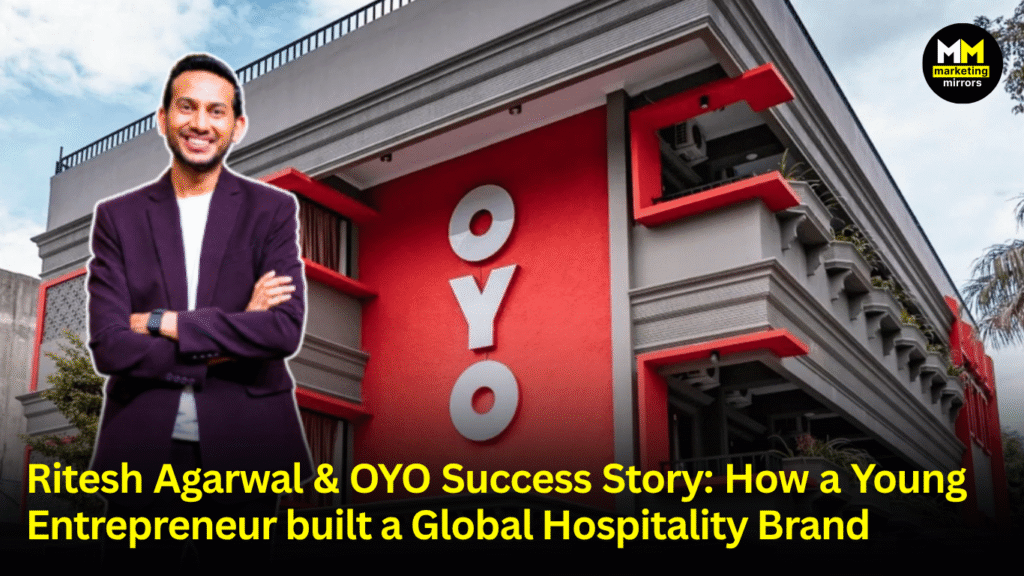
The story of Ritesh Agarwal and OYO is one of India’s most well-known startup journeys.
What started with a young entrepreneur trying to solve a problem in India’s budget accommodation market eventually became a global hospitality business.
But the journey wasn’t a straight road to success. OYO went through rapid expansion, huge investments, operational challenges, the COVID-19 crisis and a major business restructuring before moving toward profitability.
Today, OYO’s parent company, PRISM, operates across international markets and has transformed significantly from the company Ritesh started as a teenager.
Who is Ritesh Agarwal?
Ritesh Agarwal grew up in Rayagada, Odisha, in a middle-class family.
From a young age, he was interested in technology, business and entrepreneurship.
While studying in Kota, he started travelling frequently to Delhi and connecting with startups. Instead of following the conventional education-to-job path, he became increasingly interested in building businesses.
His interest eventually led him to explore India’s growing startup ecosystem.
One of his early ventures was Oravel Stays, which focused on listing and booking affordable accommodation.
The Problem Ritesh Agarwal Discovered
While travelling across India, Ritesh stayed in numerous budget hotels, guesthouses and bed-and-breakfast properties.
He noticed something frustrating.
Two hotels could charge similar prices but provide completely different experiences.
One might have clean rooms, good service and working facilities.
Another might have poor hygiene, unreliable amenities and disappointing service.
Ritesh initially believed the major problem was simply helping customers discover affordable accommodation.
But after spending considerable time experiencing the market himself, he reached a different conclusion:
The real problem was standardization.
Customers wanted to know what they were going to get before booking a room.
That insight became the foundation for OYO.
From Oravel Stays to OYO
In 2012, Ritesh started Oravel Stays.
The original concept was closer to an online marketplace where budget accommodation providers could list their properties.
However, the model wasn’t producing the results he wanted.
Instead of abandoning the entire idea, Ritesh changed the direction of the company.
The new concept was:
Find existing hotels → standardize them → brand them → bring them onto one platform → give customers a predictable experience.
This became OYO Rooms.
The company began operating with standardized facilities and a consistent customer proposition rather than functioning simply as a hotel-listing website.
The Thiel Fellowship Changed Everything
One of the biggest turning points in Ritesh Agarwal’s early career was his selection for the Thiel Fellowship in 2013.
He became the first Indian to receive the fellowship, which provided $100,000 along with mentorship and access to a global entrepreneurial network.
The fellowship was designed to support young entrepreneurs who wanted to work on ambitious businesses rather than follow a conventional college path.
Ritesh used the opportunity to focus heavily on developing the OYO concept.
The experience also encouraged him to think much bigger about the potential size of the business.
How OYO’s Business Model Works
OYO’s original business model was built around a simple problem:
Hotels had rooms, but many lacked strong branding, technology, standardized operations and consistent customer demand.
OYO attempted to solve both sides of the marketplace.
For Hotel Owners
OYO could provide:
- Brand recognition
- Technology
- Online distribution
- Customer bookings
- Pricing support
- Marketing
- Operational guidance
- Standardization
For Customers
OYO offered:
- Online booking
- Standardized rooms
- Predictable amenities
- Multiple price points
- Digital payments
- Customer support
The model essentially connected hotel owners and customers while OYO provided the technology, brand and operating framework between them.
OYO Revenue and Financial Performance
The company’s recent financial performance shows how dramatically the business has changed.
For FY2026, PRISM reported approximately:
| Financial Metric | FY2026 |
|---|---|
| Revenue | ₹9,358 crore |
| EBITDA | ₹2,594 crore |
| Net Profit | ₹994 crore |
| Gross Booking Value | ₹30,683 crore |
Revenue increased by approximately 50% year over year.
However, the ₹994 crore net profit needs some context.
Approximately ₹678 crore of the reported profit came from a deferred-tax credit, meaning the headline profit number should not be interpreted as entirely coming from normal operating performance.
That distinction matters when evaluating whether a company is genuinely becoming more profitable.
OYO Was More Than a Hotel Booking App
One common misunderstanding is that OYO was simply another hotel-booking platform.
Its model was different from a traditional booking marketplace.
OYO worked closely with hotel partners and attempted to standardize their properties under the OYO brand.
This could include everything from room presentation and amenities to pricing and customer experience.
In its early years, the company therefore operated much more like a hospitality network than a simple online travel agency.
How OYO Made Money
OYO’s revenue model evolved as the company grew.
Broadly, its business has generated revenue through relationships with property partners and hospitality services.
Depending on the arrangement, OYO could earn through:
- Commission or revenue-sharing arrangements
- Hotel management services
- Franchise arrangements
- Technology and distribution services
- Other hospitality-related services
As the company expanded, it also entered different hospitality segments.
These included:
- Budget hotels
- Premium hotels
- Vacation homes
- Long-term accommodation
- Corporate stays
- Wedding venues
- International hospitality businesses
This allowed OYO to move beyond its original budget-hotel positioning.
The Explosive Growth of OYO
OYO expanded extremely quickly.
The company attracted significant investment from major venture capital firms, with SoftBank becoming one of its most important investors.
The funding allowed OYO to expand aggressively across India and international markets.
At its peak expansion phase, OYO entered countries including:
- China
- Indonesia
- Malaysia
- Japan
- Europe
- The United States
The strategy was ambitious:
Build a global hospitality brand by bringing fragmented hotels under one technology-driven network.
By 2019, OYO had expanded to tens of thousands of properties and hundreds of thousands of rooms globally.
OYO Expands Into Premium Hospitality
OYO also moved beyond the image of being only a budget hotel company.
Over time, it introduced and developed different hospitality formats and brands.
The broader strategy became a multi-brand hospitality platform capable of serving different customer segments.
This allowed the company to participate in:
- Budget travel
- Premium stays
- Resorts
- Vacation homes
- Corporate accommodation
- Long stays
- Experiential hospitality
The company was gradually becoming more diversified.
OYO Goes Global
International expansion eventually became an important part of OYO’s business.
One of the most significant recent developments was OYO’s acquisition of G6 Hospitality, the US-based hospitality company behind brands including Motel 6.
The transaction was completed in December 2024 and gave OYO a much larger presence in the US hospitality market.
This acquisition became an important contributor to the company’s subsequent growth.
Today, the company operates across more than 35 countries, with international operations accounting for the majority of its revenue according to recent reporting.
OYO’s Parent company is Now PRISM
OYO has also undergone a corporate transformation.
Its parent company is now known as PRISM.
This reflects the evolution of the business from a relatively focused hotel-booking and budget-hospitality startup into a broader global hospitality platform.
OYO remains its best-known consumer brand, but the parent company now operates a much wider portfolio of hospitality businesses.
The OYO IPO
After years of growth and restructuring, OYO has continued moving toward a public-market listing.
The company has updated its plans for an IPO, with its parent PRISM proposing a fresh issue of approximately ₹6,650 crore.
The proposed structure does not include an offer for sale from existing investors, meaning the proceeds would primarily go toward the company rather than providing an exit for existing shareholders.
The IPO would represent another major milestone in Ritesh Agarwal’s journey from teenage entrepreneur to the head of a global hospitality company.
About Marketing Mirrors
Marketing Mirrors is a fast-growing digital storytelling platform that showcases real-life success stories of Indian entrepreneurs, creators, and innovators. Through their content, they highlight brands and individuals who’ve turned ideas into impact — inspiring thousands to chase their dreams