How Manam Chocolate started
India has a long history of sweets, but the premium chocolate market has traditionally been dominated by international brands.
Chaitanya Muppala saw an opportunity in something much closer to home: Indian cacao.
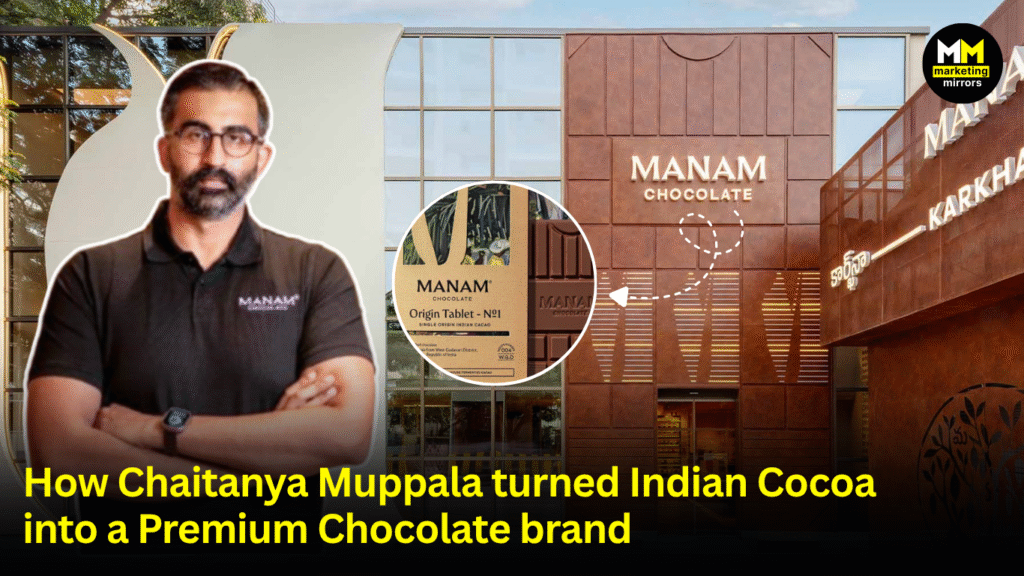
Chaitanya, a Hyderabad-based entrepreneur and the founder of Manam Chocolate, wanted to prove that cacao grown in India could be transformed into high-quality craft chocolate with its own distinctive identity.
His idea wasn’t simply to launch another chocolate brand.
He wanted to build a business that connected farmers, cacao, fermentation, chocolate-making and consumers under one integrated model.
The groundwork for the business began in 2021, while Manam’s flagship chocolate experience opened to the public in Hyderabad on 15 August 2023.
Who Is Chaitanya Muppala?
Chaitanya Muppala comes from Hyderabad’s well-known food and sweets industry.
He was involved with Almond House, the family business, where he gained experience in food retail, consumer preferences and scaling a traditional food business.
But chocolate became a different kind of obsession.
Chaitanya spent years studying cacao and chocolate-making and eventually became a Level 3 Certified Chocolate Taster, accredited by the International Institute of Chocolate and Cacao Tasting.
His experience gave him an unusual combination of skills:
Traditional Indian food business + modern consumer branding + chocolate expertise.
That combination became the foundation for Manam Chocolate.
From Farm to Chocolate Bar
Manam’s business goes much deeper than simply buying cocoa beans and manufacturing chocolate.
Its parent company, Distinct Origins, works across several stages of the value chain.
The process broadly looks like:
Cacao farming → Fermentation → Processing → Chocolate making → Product development → Retail
Manam works with more than 250 farmers cultivating over 3,000 acres of cacao, with a significant presence in West Godavari, Andhra Pradesh.
The company also operates the Distinct Origins Cacao Fermentery in Tadikalapudi, where post-harvest processing and fermentation are carried out.
This allows the company to influence the quality and flavour of the cacao before it reaches the chocolate-making stage.
Why Farmers Are Important to the Business
One of Manam’s strongest differentiators is its farmer-focused supply chain.
Instead of treating farmers simply as suppliers, the company works closely with them to improve cacao quality and post-harvest practices.
This creates a valuable business cycle:
Better farming → Better cacao → Better fermentation → Better chocolate → Premium pricing
The company also focuses heavily on traceability and origin.
This allows the brand to tell consumers where its cacao comes from and connect the final chocolate product with the farmers and farms behind it.
For a premium food brand, that story can add significant value.
The Manam Chocolate Karkhana
Manam’s first flagship location opened in Banjara Hills, Hyderabad, in August 2023.
But it wasn’t designed like a traditional chocolate shop.
The company created the Manam Chocolate Karkhana, an experience that combines chocolate manufacturing, retail, desserts and education.
Customers can explore different chocolate products, watch aspects of the chocolate-making process and experience the brand beyond simply buying a packaged chocolate bar.
The Karkhana essentially turns manufacturing into entertainment.
And humans do love paying extra to watch something being made that they could have simply bought off a shelf. Fortunately, in this case, the experience actually supports the brand.
Manam Chocolate Business Model
Manam’s business model combines D2C, premium retail, experiential stores and vertical integration.
1. Farmer Network
The company works with cacao farmers and focuses on improving the quality of Indian cacao.
2. Fermentation
The company controls an important stage of the cacao supply chain through its fermentation facility.
3. Chocolate Manufacturing
The processed cacao is converted into chocolate and confectionery products.
4. Premium Retail
Customers can purchase products through Manam’s physical stores.
5. Direct-to-Consumer Sales
The company also sells products online to customers across India.
6. Gifting
Chocolate gifting represents an important revenue stream for the business.
7. Experiential Retail
Instead of simply selling chocolate, Manam creates destinations where customers can experience the product and its manufacturing process.
This gives the business multiple revenue channels.
How Manam Makes Money
The company doesn’t depend entirely on chocolate bars.
Its revenue comes from a broader ecosystem of products and experiences.
These include:
- Chocolate bars
- Premium confectionery
- Gifting boxes
- Desserts
- Beverages
- Bakery products
- Retail sales
- Online sales
- Experiential chocolate experiences
According to recent reporting, gifting contributes the largest share of Manam’s revenue, while e-commerce contributes roughly 20% of sales.
This is an important part of the company’s strategy.
Instead of competing only for the consumer who wants a ₹100 chocolate bar, Manam can also target customers spending significantly more on premium gifting, desserts and experiences.
Manam Chocolate Revenue
Manam has grown rapidly since launching its flagship business.
According to recent reports, the company generated approximately ₹53 crore in revenue during FY2025-26.
The company is targeting around ₹125 crore in revenue in FY2026-27 and has discussed a longer-term target of approximately ₹260 crore.
| Period | Revenue |
|---|---|
| FY2025-26 | ₹53 crore |
| FY2026-27 target | ₹125 crore |
| Longer-term target | ₹260 crore |
These figures represent reported revenue and company targets, not guaranteed future results.
The growth demonstrates the company’s ambition to move from a niche craft-chocolate brand toward a much larger premium chocolate business.
Manam Chocolate Raises $9 Million
In June 2026, Manam Chocolate raised $9 million in Series A funding.
The round was led by Omnivore, with participation from the Turner Morrison consortium.
The funding is being used to accelerate the company’s expansion, particularly its retail footprint.
The company plans to open additional stores in Delhi-NCR and eventually expand into other major Indian cities such as Mumbai and Bengaluru.
The goal is to build a much larger national premium chocolate brand.
What Makes Manam Different?
Manam isn’t trying to become another mass-market chocolate company.
Its positioning is built around Indian cacao and premium experiences.
There are several important differences in its approach.
Indian Cacao
The company puts Indian-grown cacao at the centre of its brand.
Vertical Integration
It controls multiple stages of the value chain instead of simply buying finished chocolate.
Farmer Relationships
Its supply chain is closely connected with cacao farmers.
Premium Positioning
The company focuses on craft chocolate, gifting and premium experiences rather than competing primarily on price.
Experiential Retail
Its stores are designed to be destinations rather than ordinary retail outlets.
This combination gives Manam a distinct position in India’s chocolate market.
Manam’s Target Market
Manam isn’t primarily targeting consumers looking for inexpensive everyday chocolate.
Its customers include people interested in:
- Premium chocolates
- Gourmet food
- Gifting
- Indian-origin products
- Craft food
- Unique desserts
- Chocolate experiences
The company is therefore competing in a much larger premium opportunity rather than limiting itself to the niche craft-chocolate segment.
According to recent company commentary, Manam sees India’s premium chocolate market as a roughly ₹5,000 crore opportunity, with a significant portion currently represented by imported brands.
That creates a major opening for a strong Indian premium chocolate brand.
About Marketing Mirrors
Marketing Mirrors is a fast-growing digital storytelling platform that showcases real-life success stories of Indian entrepreneurs, creators, and innovators. Through their content, they highlight brands and individuals who’ve turned ideas into impact — inspiring thousands to chase their dreams