In India’s startup ecosystem, companies are often associated with billion-dollar funding rounds, aggressive advertising and rapid expansion.
Zerodha is different.
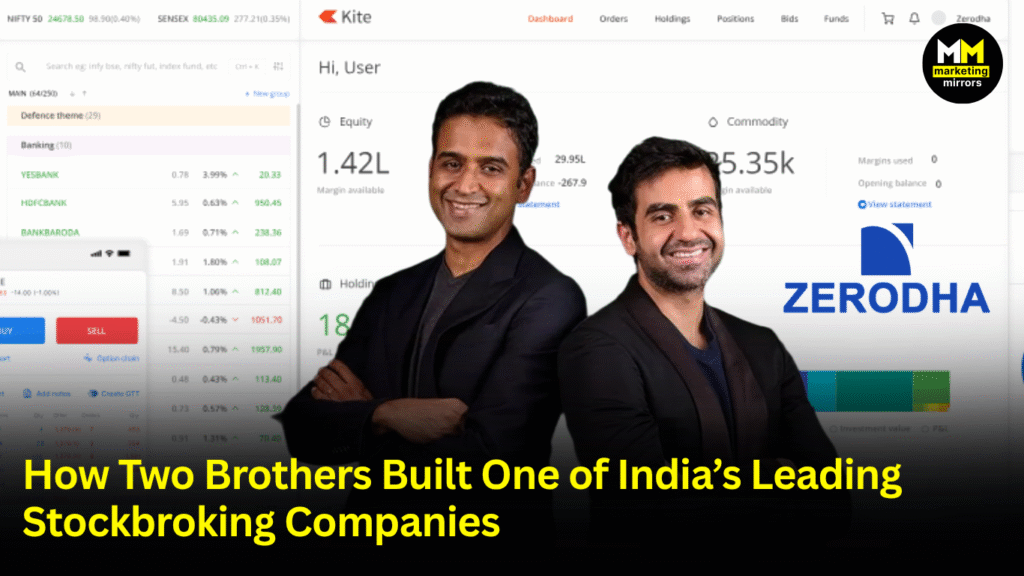
Founded by brothers Nithin Kamath and Nikhil Kamath in 2010, Zerodha built one of India’s largest stockbroking businesses without following the traditional venture-capital playbook.
The company started with a simple idea: make trading cheaper, simpler and more accessible for Indian investors.
More than a decade later, Zerodha has become a major force in India’s financial markets, with 1.6+ crore customers, around ₹6 lakh crore of equity investments held through its platform and roughly 15% of daily retail exchange volumes, according to Zerodha.
But the numbers are only one part of the story.
The more interesting question is:
How did two brothers build such a massive financial business without depending on external investors?
Who Founded Zerodha?
Zerodha was founded by brothers Nithin Kamath and Nikhil Kamath.
Nithin Kamath — The Trader Who Became an Entrepreneur
Nithin Kamath is the founder and CEO of Zerodha.
His entrepreneurial journey began with the stock market.
He started trading at a young age and spent around 15 years in the markets before starting Zerodha. During those years, he experienced the problems faced by traders firsthand.
He eventually realized that the traditional brokerage industry had a major disconnect.
Customers were increasingly moving online, but many brokers were still operating expensive offline businesses involving branches, relationship managers and other layers of infrastructure.
Those costs ultimately got passed on to customers.
Nithin saw an opportunity.
Instead of building another traditional brokerage, he wanted to create a company that was:
Online-first + technology-driven + low-cost.
That idea became Zerodha.
Nikhil Kamath’s Journey
Nikhil Kamath, Nithin’s younger brother, became Zerodha’s co-founder and later took on the role of Chief Investment Officer and CFO.
While Nithin brought extensive trading experience and the vision for Zerodha, Nikhil developed his own experience in trading and investing.
Zerodha’s official profile describes Nikhil as an experienced investor who heads the company’s financial planning.
The brothers’ complementary roles became an important part of Zerodha’s development.
Nithin focused heavily on the company’s product, business and customer philosophy, while Nikhil brought his experience in investing and financial management.
How Did Zerodha Start?
Zerodha went live for retail trading on 15 August 2010.
The name itself represents the company’s philosophy.
Zero + Rodha
“Rodha” is associated with barriers or obstacles.
The idea was to remove the barriers between ordinary Indians and financial markets.
At the time, the brokerage industry was largely built around traditional structures.
Zerodha wanted to eliminate unnecessary costs.
Its approach was simple:
Stay online.
Keep the technology fast.
Provide good support.
Charge less.
Nithin had already spent years interacting with traders and brokerage firms, so he understood the problem from both sides.
Zerodha Started With Very Little Money
One of the most remarkable aspects of Zerodha’s story is how little money was required to get the initial business running.
In 2025, Nithin Kamath explained that the company had spent roughly ₹10 lakh to develop Zerodha in its early days.
He broke the initial spending down into approximately:
- ₹2.5 lakh for the website
- ₹5 lakh for office interiors
- ₹2.5 lakh for miscellaneous expenses
The company also benefited from the availability of the then-free NSE NOW trading platform and a low-cost back-office arrangement.
This was fundamentally different from the modern startup model of raising crores before building a business.
Zerodha had to prove that customers would actually pay for its service.
The Big Idea: Make Brokerage Cheaper
Zerodha’s biggest disruption came from its pricing model.
Traditional brokers generally charged commissions based on the value of transactions.
Zerodha introduced a low-cost discount brokerage model that made trading much cheaper for retail investors.
The company also became known for zero brokerage on equity delivery trades. Zerodha still highlights this as one of its distinguishing features.
The strategy was powerful because the value proposition was extremely easy to understand:
Why pay a large brokerage fee when technology can make the service cheaper?
This helped Zerodha attract traders who were frustrated with traditional brokerage costs.
How Does Zerodha Make Money?
This is one of the most important parts of the Zerodha business story.
If Zerodha offers zero brokerage on equity delivery, how does the company make billions of rupees?
The answer is that not all financial products have zero brokerage.
Zerodha generates revenue from multiple parts of its financial-services ecosystem.
1. Intraday Trading
Zerodha charges brokerage on eligible intraday trades, subject to its applicable pricing structure.
2. Futures & Options
F&O trading has historically been an important revenue contributor for Indian brokers, including Zerodha.
The growth of derivatives trading in India played a major role in the brokerage industry’s profitability.
3. Other Trading Charges
The company earns through applicable brokerage and service-related charges across different products.
Some transaction-related charges are collected from customers and passed on to exchanges or regulators rather than being pure Zerodha revenue. Zerodha has previously explained that a significant portion of reported revenue can represent such pass-through charges.
4. Margin Trading Facility
Zerodha has also expanded into Margin Trading Facility (MTF).
In 2025, its MTF book reportedly reached around ₹3,000 crore within six months of launch, creating another potential revenue stream.
5. Financial Products
Zerodha’s ecosystem has expanded beyond traditional brokerage into areas such as mutual funds, asset management, lending and other financial products.
Zerodha’s Major Products
Zerodha is no longer simply a stockbroking app.
It has developed an ecosystem around investing.
Kite
Kite is Zerodha’s flagship trading platform.
It allows users to trade and monitor financial markets through web and mobile interfaces.
Its minimalist design became one of the company’s most recognizable product characteristics.
Coin
Coin is Zerodha’s platform for investing in mutual funds.
It allowed the company to move beyond active traders and attract long-term investors.
Console
Console provides portfolio and account-related information.
Investors can use it to monitor holdings, transactions and other investment data.
Varsity
Varsity is Zerodha’s financial education platform.
It offers educational material covering subjects such as:
- Stock investing
- Fundamental analysis
- Technical analysis
- Options
- Futures
- Personal finance
- Mutual funds
This was strategically important.
Instead of simply asking people to invest, Zerodha also created resources to help them understand investing.
Zerodha’s Financial Performance
Zerodha became one of India’s most profitable fintech companies.
For FY24, Nithin Kamath said Zerodha generated around ₹8,370 crore in revenue and approximately ₹4,700 crore in profit in his September 2024 update.
Other reported financial data for FY24 puts revenue at approximately ₹9,994.5 crore and net profit at ₹5,493.4 crore, depending on the accounting period and reporting basis used.
For FY25, reported company-level figures showed revenue of approximately ₹8,868 crore, while net profit fell to about ₹4,237 crore.
The decline was significant, but it doesn’t mean Zerodha suddenly became an unprofitable business.
It remained extraordinarily profitable.
The change reflected an important reality:
A brokerage business is heavily influenced by trading activity and regulation.
Why Has Zerodha Not Gone Public?
Many billion-dollar companies eventually pursue an IPO.
Zerodha has not.
Nithin Kamath has repeatedly indicated that the company doesn’t currently see a compelling reason to go public.
One reason is simple:
Zerodha doesn’t need the money.
The business generates substantial profits internally.
Going public would also bring additional regulatory requirements, public-market expectations and shareholder pressure.
For a company that has deliberately built its culture around long-term independence, staying private can be attractive.
Zerodha’s Customer Base
Zerodha has grown from a small brokerage serving thousands of customers to a platform with more than 1.6 crore customers.
The company says its customers hold around ₹6 lakh crore of equity investments through the platform and contribute roughly 15% of India’s daily retail exchange volumes.
The scale is extraordinary.
But an even more interesting statistic emerged in 2025.
Zerodha said nearly 11% of India’s retail and HNI equity holdings were sitting in its demat accounts.
That shows how deeply the platform has penetrated India’s retail investing ecosystem.
Zerodha’s Expansion Beyond Brokerage
Zerodha eventually started building a much broader financial ecosystem.
Rainmatter
Rainmatter is Zerodha’s fintech investment and incubation initiative.
It supports startups working across financial technology and capital markets.
The objective is not simply to build Zerodha’s own products.
It is also to help create a larger ecosystem around financial services.
Zerodha Fund House
Zerodha has also entered asset management.
Zerodha Fund House launched its first fund in 2023.
By April 2026, Zerodha said the fund house was managing approximately ₹15,000 crore across 17 funds, with more than 11.5 lakh investors.
This is an important development because it shows Zerodha moving from:
Brokerage → Investing → Asset Management
rather than remaining dependent on one business line.
Zerodha Capital
Another part of the ecosystem is Zerodha Capital, its NBFC arm.
It focuses on credit products such as loans against securities.
In FY25, Zerodha Capital reported approximately ₹36 crore in revenue and ₹12.5 crore in net profit.
Although small compared with Zerodha’s core brokerage business, it represents another attempt to diversify the company’s financial-services operations.