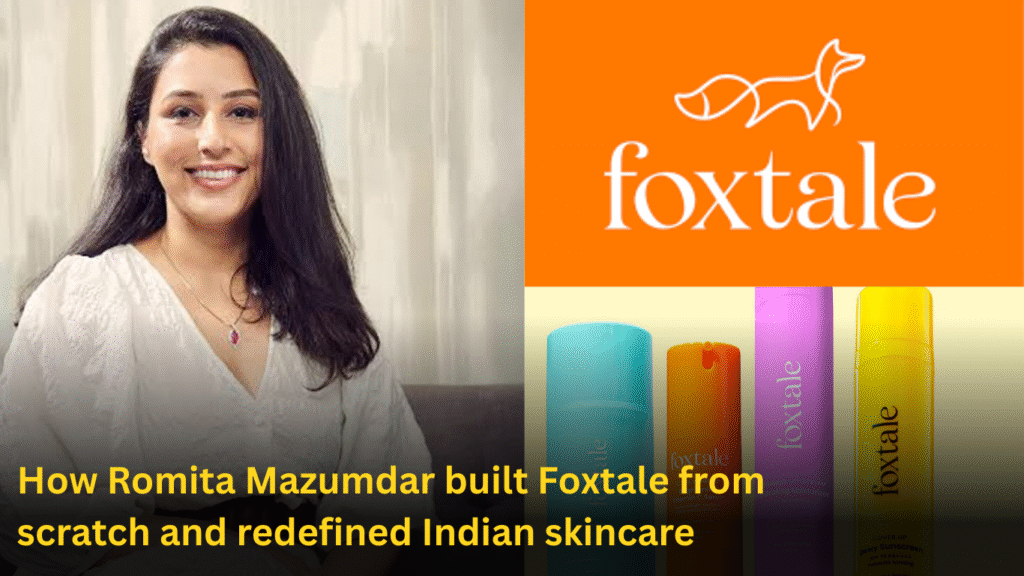
India’s beauty and personal-care market has exploded over the last few years, but very few founders have disrupted it with the precision, consumer understanding, and scientific rigor that Romita Mazumdar brought with Foxtale.
In just a short span, she built a skincare brand that crossed ₹700 crore GMV, attracted global investors, and now expanded into a new bodycare brand called Hula Hoop, designed to give India its own Sol de Janeiro moment.
Below is the complete journey — founding story, revenue trajectory, funding milestones, expansion, and their unique marketing revolution at the end.
How It All Started: The Founder and the Vision
Before her entrepreneurial leap, Romita worked in a finance/investment role. What sparked Foxtale wasn’t a corporate strategy—it was her frustration with skincare products that didn’t work for real Indian skin issues.
She personally interacted with over 3,000 Indian consumers, mapping patterns in concerns like:
- Acne
- Pigmentation
- Sensitivity
- Heat-induced skin dullness
- Oily-but-dehydrated skin
Her conclusion was simple: India needed skincare built for Indian climate + Indian skin biology + Indian lifestyles.
That belief shaped Foxtale’s core philosophy:
- Science-led formulations
- Active ingredients designed for Indian weather
- Rigorous clinical testing
- High repeat-purchase focus instead of vanity SKUs
- Community-first product creation
Founding Year and Early Build
- Foxtale was legally founded in May 2021.
- Commercial operations and product rollout began around January 2022.
- The brand launched with a tight, data-backed lineup: moisturizers, sunscreen, serums, and cleansers.
This disciplined approach prevented unnecessary dilution and helped Foxtale build trust quickly.
Revenue & Growth Trajectory: From Crores to Hyper-Scale
FY 2022–23 (Year 1)
- Revenue: ~₹14 crore
- The brand was still investing heavily in marketing, community building, and clinical trials.
FY 2023–24
- Revenue shot up to ₹83–175 crore depending on the reporting source.
- Losses widened due to aggressive expansion, but the brand’s repeat rates kept growing.
FY 2024–25 (Projected)
- Foxtale expects ₹400–450 crore gross revenue.
- Aims for EBITDA-positive operations by year-end.
Long-Term Goal
- Build a ₹1,000 crore brand within 3–5 years
- Maintain strong margins via scale + omnichannel + repeat rates
Business Model and Distribution
Foxtale built its growth engine through a balanced distribution structure. Around half of its revenue comes directly from its D2C website, helping the brand control customer experience and build loyalty. Another 40 percent flows in through major online marketplaces, giving Foxtale scale and visibility. The remaining 10 percent comes from offline retail, which strengthens physical presence and helps customers who prefer in-store trials. Today, Foxtale sells in 100+ cities with 18 to 20 high-performing SKUs.
Expansion into Bodycare with Hula Hoop
In 2025, Foxtale transitioned into a House of Brands by launching Hula Hoop, a bodycare brand tailored specifically for common Indian skin concerns. Issues like pigmentation, body acne, dark elbows, rough texture, and uneven tone are widespread yet rarely addressed with active-ingredient solutions. Hula Hoop tackled these gaps with science-backed formulas. Within six months, the brand became a ₹40 crore category, turned profitable early, and expanded its initial six SKUs to 13–14. It now targets ₹150 crore in the next financial year and a ₹650 crore net-revenue brand within five years.
Challenges and Growth Realities
Rapid scale brought heavy operational pressure. Annual expenses shot up from ₹33 crore to ₹139 crore, widening FY24 losses to ₹55 crore. High burn came from influencer partnerships, media buying, and product innovation, while early customer acquisition costs reached roughly ₹1.67 per ₹1 earned. Despite the financial strain, Foxtale continues to attract investor confidence due to its strong repeat-purchase rates, retention, and ability to solve large, underserved consumer problems. This entire journey shows how modern beauty brands can grow by pairing sharp consumer insight with disciplined execution.
aims to become a ₹650 crore net-revenue brand within five years.
About Marketing Mirrors
This story is brought to you by Marketing Mirrors, a digital platform dedicated to spotlighting inspiring entrepreneurs, creators and innovative businesses across South Asia. Our mission is simple: to reflect the reality of modern entrepreneurship and bring powerful stories to the world.