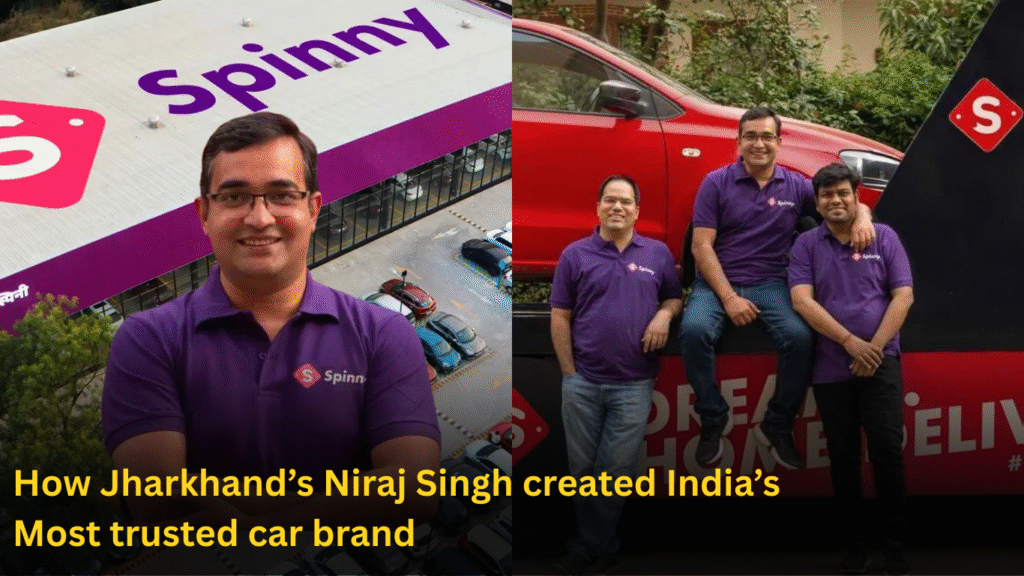
The journey of India’s used-car market has always been complicated. Endless negotiations, hidden defects, inconsistent pricing and a complete lack of trust shaped the experience for millions of buyers. In 2015, Niraj Singh, an IIT Delhi graduate and a serial entrepreneur from Jharkhand, decided he had seen enough of this chaos. What he built next reshaped the way Indians think about pre-owned cars.
Today, his startup Spinny stands as one of India’s most trusted used-car brands, valued at $2.1 billion, operating 90+ hubs, and employing more than 2,000 people. This is the story of how one founder turned a fragmented industry into a transparent, tech-driven ecosystem.
A Founder Who Saw the Market’s Biggest Flaw: Trust
Before Spinny took shape, Niraj Singh dabbled in multiple ventures, from TechMonkey to Locus Education. But it was his real-life experience of buying a used car that sparked the idea for Spinny. The lack of transparency in India’s used-car ecosystem convinced him that buyers deserved a safer, more reliable, and more professional experience.
Instead of creating yet another listing platform, he envisioned something different:
A full-stack model where every car is inspected, certified, priced, and delivered by the same company.
This simple shift made all the difference.
Building Spinny: From Bootstrapped Beginnings to a National Brand
When Spinny launched, the used-car market was highly fragmented and dominated by middlemen. Buyers rarely trusted sellers. Sellers doubted prices. And the overall experience felt unpredictable.
Niraj’s solution was a 200-point inspection system, transparent pricing, and a 5-day money-back guarantee. These features gave customers confidence like never before.
Early challenges were tough:
Investor skepticism, slow adoption, and long months where the founding team barely drew salaries. But every obstacle strengthened the platform and pushed it closer to its goal.
Over the next few years, Spinny expanded across major Indian cities including:
- Delhi NCR
- Bengaluru
- Mumbai
- Hyderabad
- Chennai
- Pune
- Ahmedabad
The company’s customer-first approach quickly set it apart.
Funding Milestones That Powered Spinny’s Growth
In December 2021, Spinny raised $283 million from top global investors. This round pushed the company’s valuation to $2.1 billion, officially making it a unicorn.
Strategic acquisitions such as Truebil and Scouto further strengthened Spinny’s capabilities in vehicle diagnostics, inspections, and inventory management.
Today, Spinny operates India’s largest network of full-stack used-car retail hubs, offering a seamless online-to-offline experience. With doorstep test drives, transparent reports, and a customer-centric workflow, the company continues to transform the market.
Revenue Channels
Spinny earns revenue from multiple streams, which strengthens the business:
Primary Revenue
Sale of refurbished used cars
Spinny buys at X and sells at X + margin (usually 7% to 12%).
Secondary Revenue Streams
- Value-added warranties
- Finance commissions (loans partnered with banks/NBFCs)
- Insurance partnerships
- Accessories
- Convenience services like doorstep delivery
This diversified model creates reliable, scalable income.
Data & Algorithmic Pricing
Spinny uses real-time data from:
- Market demand
- Historical sales
- Depreciation analysis
- Car age & mileage patterns
- Regional price differences
Its pricing engine ensures the company stays competitive while maintaining profitability.
Revenue Insights & Funding Growth
While Spinny doesn’t publicly disclose exact revenue every year, here is what is verified from credible reports:
Valuation Growth
- 2020: ~USD 350 million
- 2021: USD 1.8 billion
- 2022–2023: Stabilized at USD 2.1 billion
Funding Highlights
- $283 million raised in 2021
Led by Tiger Global, Avenir Growth, and ADQ - Post funding, Spinny entered India’s unicorn club
Estimated Revenue Patterns
Based on industry benchmarks for inventory-led used-car companies:
- FY 2021–22: Approx ₹900–1100 crore GMV
- FY 2022–23: GMV expected to cross ₹2,500 crore
- Vehicle sales per month: Estimated 3,000–5,000 cars
- Average margin per car: ₹40,000–₹75,000 depending on segment
About Marketing Mirrors
At Marketing Mirrors, we deliver high-quality business insights, brand breakdowns, startup stories, and marketing deep-dives.
Our goal is to educate, inspire, and equip readers with research-backed content that reflects real industry intelligence.