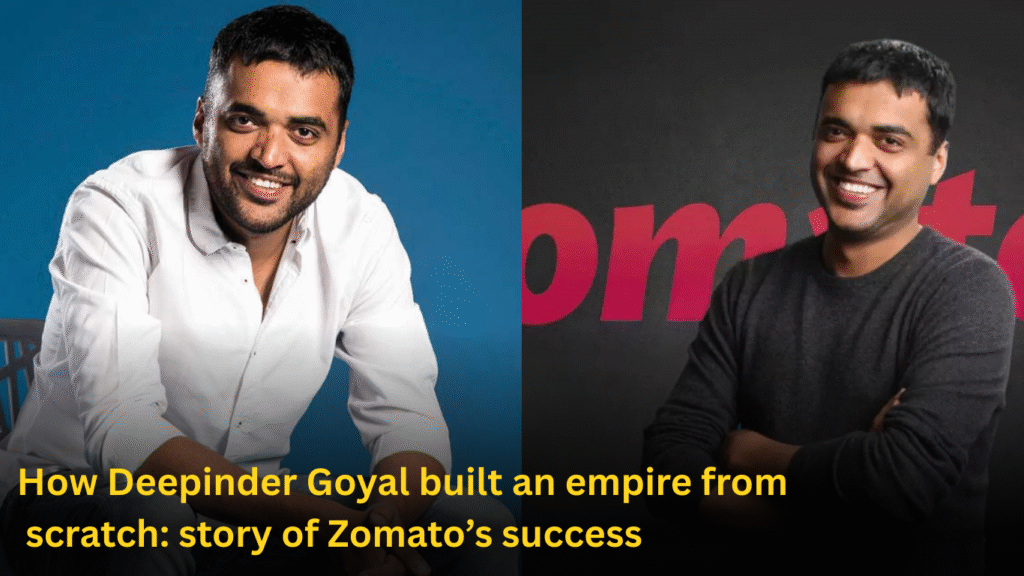
Deepinder Goyal’s rise to the top of the Hurun India 2025 Self-Made Entrepreneurs list is not a story of overnight success or sudden market hype. It is the result of nearly two decades of persistence, experimentation, and disciplined execution that transformed Zomato from a simple menu-listing website into one of India’s most valuable and profitable consumer technology companies.
As the founder and CEO of Eternal, formerly known as Zomato Ltd, Goyal represents a new generation of Indian entrepreneurs who built at scale first, endured long phases of losses, and then restructured their businesses for sustainable profitability.
About theFounder: Deepinder Goyal
Deepinder Goyal is an alumnus of IIT Delhi, where he studied Mathematics and Computing. After graduating, he joined Bain & Company as a management consultant. His early exposure to structured problem-solving, data analysis, and operational efficiency played a key role in shaping his entrepreneurial mindset.
The idea for Zomato emerged from a simple workplace frustration. Employees at Bain struggled to access restaurant menus during lunch breaks, often relying on printed copies. Goyal digitised these menus on an internal platform, not as a startup idea, but as a practical solution. The rapid adoption of this tool revealed a much larger consumer opportunity beyond the office environment.
The Birth of Zomato: From Foodiebay to a Recognised Brand
In 2008, the internal platform was launched publicly under the name Foodiebay. The concept resonated strongly with users who were looking for reliable restaurant information, menus, and reviews in one place. As usage grew, the company rebranded as Zomato in 2010, signalling its ambition to build a global food-focused digital platform.
Over the next few years, Zomato expanded aggressively across Indian cities and later entered international markets such as the UAE, the UK, South Africa, and parts of Southeast Asia. During this phase, the company primarily generated revenue through restaurant advertising, sponsored listings, and premium visibility services. While user growth was strong, revenues were limited and the business was far from profitable.
Transition to Food Delivery: High Growth, High Losses
Around 2015–16, Zomato entered the food delivery business, transforming its role from a discovery platform into a logistics-driven service. This shift dramatically increased order frequency and user engagement but also introduced new challenges.
Food delivery brought:
- Heavy delivery partner costs
- Aggressive discounting to acquire users
- High customer acquisition expenses
- Complex logistics operations
For several years, Zomato reported large net losses, leading many analysts to question whether food delivery could ever be profitable in price-sensitive markets like India.
Despite criticism, Deepinder Goyal continued investing in scale, data infrastructure, and operational learning rather than abandoning the delivery model.
Zomato IPO and the Reality of Public Markets
In 2021, Zomato became one of India’s first major consumer internet companies to go public. The IPO was widely celebrated but also marked a turning point.
As a listed company, Zomato faced:
- Quarterly profit expectations
- Investor pressure on margins
- Reduced tolerance for prolonged losses
Public markets forced the company to mature rapidly. Growth alone was no longer enough. Profitability became non-negotiable.
Zomato’s Current Business Model (Under Eternal)
Today, Zomato operates as a multi-vertical consumer tech platform under its parent entity, Eternal.
Food Delivery
The core business, generating revenue through:
- Commissions from restaurant partners
- Delivery fees charged to customers
- In-app advertising and promotions
This segment benefits from scale and repeat usage.
Quick Commerce – Blinkit
Zomato’s acquisition of Blinkit marked its entry into instant grocery delivery. Blinkit earns revenue via:
- Product margins
- Delivery charges
- Brand placements
This vertical has shown rapid growth and improving unit economics, becoming a key future profit driver.
Dining Out and Subscriptions
Products like Zomato Gold improve customer retention, increase order frequency, and reduce reliance on discounts.
B2B Supply (Hyperpure)
Hyperpure supplies fresh ingredients directly to restaurants, adding margin stability while strengthening Zomato’s ecosystem control.
Revenue and Profit: The Numbers Behind Zomato’s Turnaround
Real financial data shows how Zomato’s revenue and profits evolved during its transformation:
For the full financial year FY25, Eternal reported consolidated revenue of approximately ₹20,243 crore, marking a 67% year-on-year increase from ₹12,114 crore in FY24. Total income, including non-operating revenue, rose to about ₹21,320 crore in FY25
In terms of profitability, the company posted a net profit of ₹527 crore in FY25, up roughly 50% from ₹351 crore in FY24. This growth highlights improved operational leverage and a shift toward sustainable business performance.
Why Deepinder Goyal Topped Hurun India 2025
The Hurun India 2025 Self-Made Entrepreneurs list ranks founders based on company valuation and long-term value creation, not just popularity. Eternal’s estimated valuation of over ₹3.2 lakh crore helped propel Deepinder Goyal to the top of this prestigious list.
This recognition reflects Zomato’s journey from steady revenue growth to sustained profitability, large-scale consumer adoption, and a resilient business model. Instead of exiting early or relying on hype, Goyal navigated public market pressures, restructured the business during lean years, and balanced growth with financial discipline.
About Marketing Mirrors
At Marketing Mirrors, we deliver high-quality business insights, brand breakdowns, startup stories, and marketing deep-dives.
Our goal is to educate, inspire, and equip readers with research-backed content that reflects real industry intelligence.