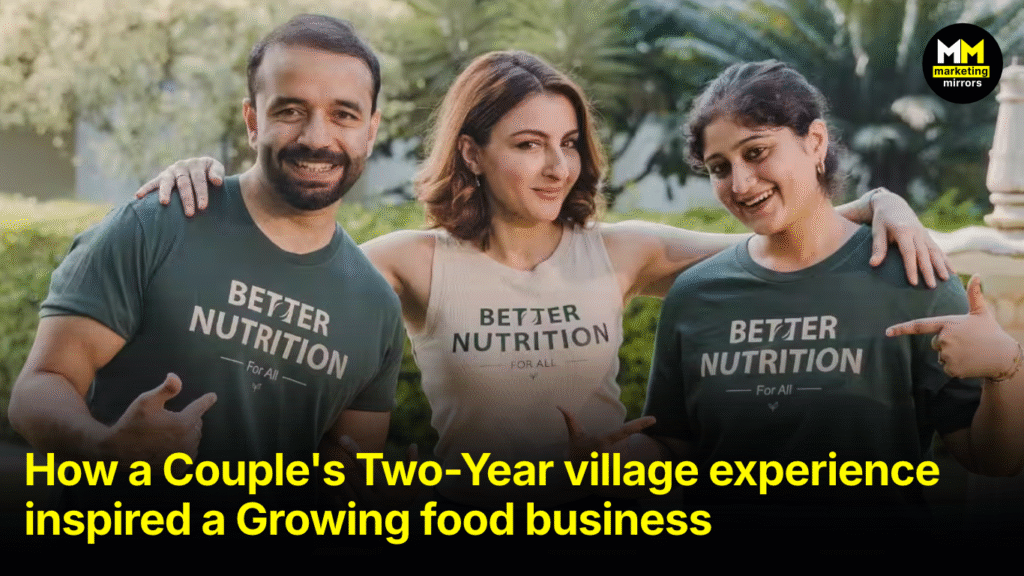
What would you do if someone asked you to leave the comfort of city life and spend the next two years living in a village, learning about farming?
For most people, that would sound like an unusual decision. But for entrepreneurs Prateek Rastogi and Aishwarya Bhatnagar, it became the foundation of a business that would eventually attract investors, celebrity supporters and national attention.
Their journey is not a typical startup success story. Instead of beginning with an office, a large team or an elaborate business plan, the couple chose to understand India’s agricultural system from the ground up.
Today, they are known for building GreenDay and Better Nutrition, businesses focused on agricultural innovation and nutrient-rich everyday food.
Who Are Prateek Rastogi and Aishwarya Bhatnagar?
Prateek Rastogi is an Indian entrepreneur and the founder and CEO of GreenDay. He studied economics at Shri Ram College of Commerce (SRCC) before completing his MBA at the Indian Institute of Management Ahmedabad (IIM Ahmedabad).
His wife and business partner, Aishwarya Bhatnagar, is the co-founder and director of GreenDay.
Together, they established a business around an important question: How can Indian farmers produce food that offers better nutritional value while also creating better opportunities for agricultural communities?
Rather than entering the food industry with a conventional business model, they decided to understand the challenges faced by farmers and explore opportunities in agricultural science.
Their approach eventually led to the development of GreenDay and its consumer-facing food brand, Better Nutrition.
The Unusual Decision That Started Their Entrepreneurial Journey
The story of Prateek and Aishwarya began through Shaadi.com, where the two first connected.
After getting married, Prateek made an unusual proposal. He wanted them to move to a village and spend more than two years understanding Indian agriculture.
Aishwarya agreed, and the couple stepped away from their comfortable urban lifestyle.
During this period, they spent time with farmers, observed agricultural practices and studied the challenges associated with growing crops with better nutritional value.
They wanted to understand farming beyond textbooks and business theories.
Their experience gave them valuable insights into soil health, crop nutrition, seed quality and the difficulties farmers face in producing and selling agricultural products.
What initially seemed like an unconventional decision eventually became the foundation of their entrepreneurial journey.
How GreenDay Was Born
Their experience in rural India helped them identify an opportunity in the agricultural sector.
They established GreenDay Farmer Solutions, a company focused on improving agricultural practices and connecting farmers with better opportunities.
The company works around the concept of biofortification, which aims to improve the nutritional value of crops through better seeds and farming practices.
Instead of focusing only on increasing crop production, GreenDay wanted to encourage the cultivation of crops with higher nutritional value.
Its approach involves working with farmers, improving soil health, promoting suitable crop varieties and developing a supply chain for nutrient-rich agricultural products.
The company’s farmer-focused initiative, Kisan Ki Dukan, is also part of its broader agricultural ecosystem.
The objective is to create value throughout the agricultural supply chain, benefiting both farmers and consumers.
Better Nutrition: Turning an Agricultural Idea into a Consumer Brand
While GreenDay focused on agricultural solutions, the founders also recognised an opportunity in the consumer food market.
This led to the development of Better Nutrition, a food brand that brings biofortified agricultural products directly to consumers.
The idea is simple: everyday food such as wheat, rice and pulses can be produced with improved nutritional value through better agricultural practices.
Most Indian households regularly consume these staples, making them an important part of everyday nutrition.
Better Nutrition aims to make nutrient-rich food more accessible without requiring consumers to completely change their eating habits.
Its product range includes:
– Biofortified wheat flour (atta)
– Bajra and ragi flour
– Different varieties of rice
– Pulses and dals
– Wheat-based pasta and other food products
The brand says its products are naturally biofortified rather than nutritionally enhanced by adding nutrients after processing.
It also describes its process of testing products for nutrients such as iron, zinc, calcium and protein.
According to its official website, the company works with a network of more than 20,000 farmers.
This approach connects agricultural innovation with the growing consumer interest in healthier everyday food.
What Is Biofortification and Why Does It Matter?
One of the most interesting aspects of Better Nutrition is its focus on biofortification.
Biofortification is an agricultural technique used to increase the nutritional content of crops while they are growing.
Traditional food fortification generally involves adding nutrients during food processing. Biofortification, on the other hand, aims to improve the nutrient content of the crop itself.
This can be achieved through methods such as:
1. Improved seeds: Selecting or developing crop varieties with higher levels of essential nutrients.
2. Better soil management: Improving the availability of nutrients in the soil.
3. Scientific farming: Using agricultural research to improve crop quality.
4. Nutritional testing: Measuring nutrient levels in harvested grains.
For example, biofortified wheat and rice can be developed to contain higher levels of nutrients such as iron and zinc.
The concept is particularly relevant in India, where wheat, rice and pulses form a major part of everyday diets.
By focusing on familiar food products, Better Nutrition aims to make improved nutrition a more convenient part of daily life.
From ₹80 Lakh to ₹14 Crore: The Business Growth Story
One of the biggest highlights of the founders’ journey is the reported growth in revenue.
During their appearance on Shark Tank India, Prateek and Aishwarya discussed how their business had grown from approximately ₹80 lakh to ₹14 crore within a year.
This represents a 17.5-fold increase based on the two reported figures.
This growth attracted attention because the founders were building a business in a sector that combines traditional agriculture with modern food innovation.
The company subsequently reported ₹11.5 crore in FY25 revenue in a Financial Express interview, illustrating why revenue figures should always be understood in their respective reporting periods and measurement bases.
Its growth strategy has included expanding its product range, reaching more consumers through digital platforms and strengthening distribution.
Their Shark Tank India Appearance
The founders gained wider public attention after appearing on Shark Tank India Season 4 in February 2025.
They presented their agricultural and food businesses to the panel of investors and explained how their unusual rural experience had shaped their business model.
During the pitch, they asked for ₹60 lakh in exchange for 1% equity, valuing the business at ₹60 crore.
Their presentation attracted interest from several investors.
Namita Thapar made an offer that included a royalty clause, while Vineeta Singh also showed interest with a different proposal.
After considering the offers, the founders accepted Namita Thapar’s deal.
Their appearance highlighted an important aspect of entrepreneurship: having an interesting idea is not enough. Founders must also demonstrate a clear business model, market opportunity and potential for growth.
Celebrity Support and Investors Behind Better Nutrition
Another interesting part of the company’s journey is the support it has received from well-known personalities.
P. V. Sindhu: The Olympic medallist has been associated with Better Nutrition as an investor and brand ambassador, bringing visibility to its focus on everyday nutrition.
Pankaj Bhadouria: The MasterChef India winner has also supported the brand, helping connect its products with everyday cooking and food culture.
Namita Thapar: The Shark Tank India investor backed the founders after their television pitch.
Such associations have helped the company gain attention beyond the traditional agricultural and food industries.
What Makes Their Business Model Interesting?
The success story of GreenDay and Better Nutrition is interesting because the founders are trying to address two connected markets: agriculture and consumer nutrition.
Their approach has several important elements:
1. Farmer-focused agriculture: The company works with farmers to encourage improved crop quality and agricultural practices.
2. Science-backed food products: Its focus on biofortification creates a point of differentiation in the competitive packaged food market.
3. Everyday consumption: Instead of introducing completely unfamiliar products, the brand focuses on familiar staples such as atta, rice and pulses.
4. Connecting farmers with consumers: The business aims to build a supply chain through which agricultural improvements can reach consumers.
5. A growing nutrition market: Increasing consumer interest in food quality and nutrition creates opportunities for businesses working in this space.
About Marketing Mirrors
Marketing Mirrors is a fast-growing digital storytelling platform that showcases real-life success stories of Indian entrepreneurs, creators, and innovators. Through their content, they highlight brands and individuals who’ve turned ideas into impact – inspiring thousands to chase their dreams.