India’s food-tech industry has spent years making it easier to order food from restaurants. ChefKart is taking a different approach.
Instead of delivering a prepared meal from a restaurant, ChefKart allows customers to book trained and verified cooks who prepare food inside their own kitchens.
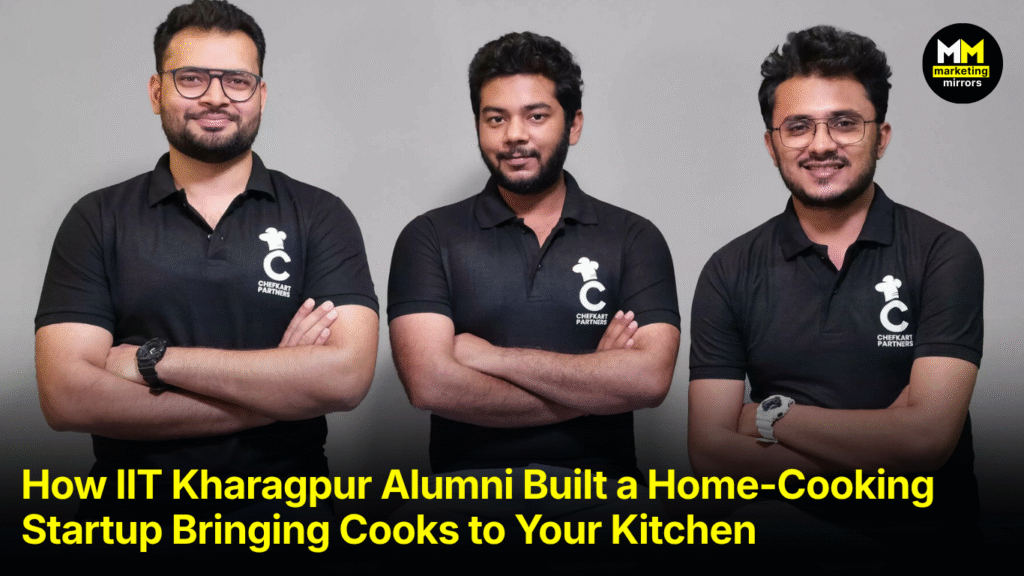
Founded in 2020 by IIT Kharagpur alumni Vaibhav Gupta, Aman Gupta and Arpit Gupta, ChefKart has built a technology-enabled platform around home cooking, offering on-demand cooking, recurring services and cooking for parties and events.
The startup has attracted funding from investors including Blume Ventures, Pravega Ventures, Titan Capital, Deepinder Goyal and Kunal Shah.
In 2026, ChefKart entered another major phase after GreetEat announced a proposed acquisition of the company.
WHAT IS CHEFKART?
ChefKart is a technology-enabled home-chef platform that connects households with professional cooks.
The concept is straightforward:
Traditional food delivery:
Restaurant → Cooked food → Delivery → Customer
ChefKart:
Customer → Book a cook → Cook arrives at home → Meal prepared in customer’s kitchen
ChefKart says its cooks go through identity verification, background checks, assessments and mandatory training before accepting household assignments.
The company is essentially trying to bring technology, standardisation and convenience to a traditionally informal household service.
WHO FOUNDED CHEFKART?
ChefKart was founded in 2020 by three IIT Kharagpur alumni.
Vaibhav Gupta
Vaibhav Gupta is the Co-Founder and CEO of ChefKart.
Aman Gupta
Aman Gupta is the Co-Founder and CTO, leading the company’s technology side.
Arpit Gupta
Arpit Gupta is also a Co-Founder of ChefKart.
The three founders built ChefKart around the idea of making reliable home-cooking services easier to discover, book and manage.
It is worth noting that some social media posts describe ChefKart as being founded by an “IIT grad duo.” However, the company was founded by three people, so describing the founding team accurately is important.
WHAT PROBLEM IS CHEFKART SOLVING?
Finding a reliable household cook can traditionally involve:
• Asking friends and neighbours
• Local recommendations
• Phone calls
• Trial periods
• Negotiating schedules
• Managing replacements
• Uncertainty about skills and reliability
ChefKart attempts to put these processes onto a technology platform.
The company handles areas such as:
• Cook discovery
• Verification
• Booking
• Payments
• Scheduling
• Customer feedback
• Training
• Service management
Its larger objective is to organise a fragmented home-cooking market and create a structured ecosystem for both households and cooks.
CHEFKART BUSINESS MODEL
1. CHEFIT: ONE-TIME COOKING
Chefit allows customers to book a cook for a single cooking session.
The service currently starts at around ₹499 per visit, with additional charges depending on the number of people and service requirements.
The platform also offers multi-visit packages that can reduce the effective cost per visit.
This model targets customers who don’t need a permanent household cook but occasionally need help preparing food.
For example:
• Working professionals
• People living alone
• Families hosting guests
• People with busy schedules
• Customers who want freshly prepared food without ordering from a restaurant
2. CHEF FOR PARTY
ChefKart also provides professional cooks for parties and gatherings.
The service is designed for customers who need temporary cooking help for events rather than everyday household requirements.
Potential use cases include:
• Birthday parties
• Family gatherings
• Dinner parties
• Small events
• Special occasions
This gives ChefKart another revenue stream beyond regular household cooking.
3. RECURRING COOKING SERVICES
ChefKart has historically offered monthly cooking services and recurring arrangements.
The idea is to provide households with a more consistent cooking solution instead of requiring them to find a new cook every time they need help.
The company’s business model has evolved over time, with the platform also offering multi-visit packages for recurring requirements.
This recurring component can potentially provide stronger customer retention because households that are satisfied with a cook may continue booking the service.
HOW DOES CHEFKART MAKE MONEY?
ChefKart’s revenue comes from transactions made through its home-cooking platform.
The company essentially monetises the connection between:
Customer demand + cooking professionals + technology + service management
Customers pay for cooking services through the platform, while ChefKart facilitates the transaction and manages the service ecosystem.
This is fundamentally different from a restaurant business.
ChefKart does not need to maintain a restaurant kitchen for every meal.
Instead, the customer’s kitchen becomes the place where the service is delivered.
That helps the company operate an asset-light model compared with traditional restaurant businesses, although it still has significant operational costs related to technology, staff, customer acquisition, cook training and service management.
WHAT DOES A TYPICAL CHEFKART BOOKING LOOK LIKE?
Imagine a customer who has no time to cook dinner.
Instead of ordering food online, the customer books a cook through ChefKart.
The cook arrives at the customer’s home, prepares the required food in the customer’s kitchen and completes the service.
The customer pays through the platform.
ChefKart therefore acts as the technology and service layer connecting the household with the cooking professional.
HOW MUCH REVENUE DOES CHEFKART GENERATE?
This is one of the most interesting parts of ChefKart’s latest business story.
ChefKart reported ₹4.83 crore in recognised revenue during 2025.
For January to July 2026, the company reported ₹6.52 crore in recognised revenue, representing a 224% year-over-year increase for the corresponding period.
Reported Revenue:
2025: ₹4.83 crore
January-July 2026: ₹6.52 crore
This means ChefKart generated more recognised revenue during the first seven months of 2026 than it reported for the entire 2025 period.
That is a significant acceleration in the business.
However, revenue growth should not automatically be confused with profitability.
And this is where ChefKart’s financial picture becomes more interesting.
HOW MUCH FUNDING HAS CHEFKART RAISED?
ChefKart has raised more than $2.6 million according to publicly reported startup funding data.
Its investors have included:
• Blume Ventures
• Pravega Ventures
• Titan Capital
• Deepinder Goyal
• Kunal Shah
• Other angel investors
One of its major funding rounds came in 2022, when ChefKart raised approximately $2 million, led by Blume Ventures and Pravega Ventures.
The funding was intended to help the company expand its technology platform, operations and network of cooking professionals.
CHEFKART’S SCALE
ChefKart has reported significant growth in its customer and cook network.
The company has reported:
• 100,000+ families served
• 5,500+ cooks trained
• Approximately 1.8 million app installations
• App installations across 50+ cities
• 3 million+ meals supported
These are company-reported figures.
An important distinction is that having app installations across 50+ cities does not necessarily mean ChefKart has active cooking operations in every one of those cities.
Its active operating footprint is smaller and continues to expand.
THE DEEPINDER GOYAL CONNECTION
One of the most notable names associated with ChefKart is Deepinder Goyal, the founder of Zomato.
Goyal participated in ChefKart’s funding alongside institutional and angel investors.
The connection is interesting from a business perspective.
Zomato helped make restaurant food ordering and delivery a mainstream digital experience.
ChefKart is working on a different part of the food ecosystem:
Getting a cooking professional into the customer’s own kitchen.
The businesses are not identical, but the comparison shows how startups continue to find new technology opportunities around everyday food habits.
CHEFKART’S PROPOSED ACQUISITION BY GREETEAT
In August 2026, GreetEat announced a binding Letter of Intent to acquire 100% of ChefKart.
If completed, ChefKart would become a wholly owned subsidiary of GreetEat.
The proposed transaction remains subject to conditions including:
• Due diligence
• Definitive agreements
• Required approvals
• Financing
• Other closing conditions
Therefore, the accurate description is:
GreetEat has proposed to acquire ChefKart under a binding LOI.
It should not yet be described as a completed acquisition.
About Marketing Mirrors
Marketing Mirrors is a fast-growing digital storytelling platform that showcases real-life success stories of Indian entrepreneurs, creators, and innovators. Through their content, they highlight brands and individuals who’ve turned ideas into impact — inspiring thousands to chase their dreams.