
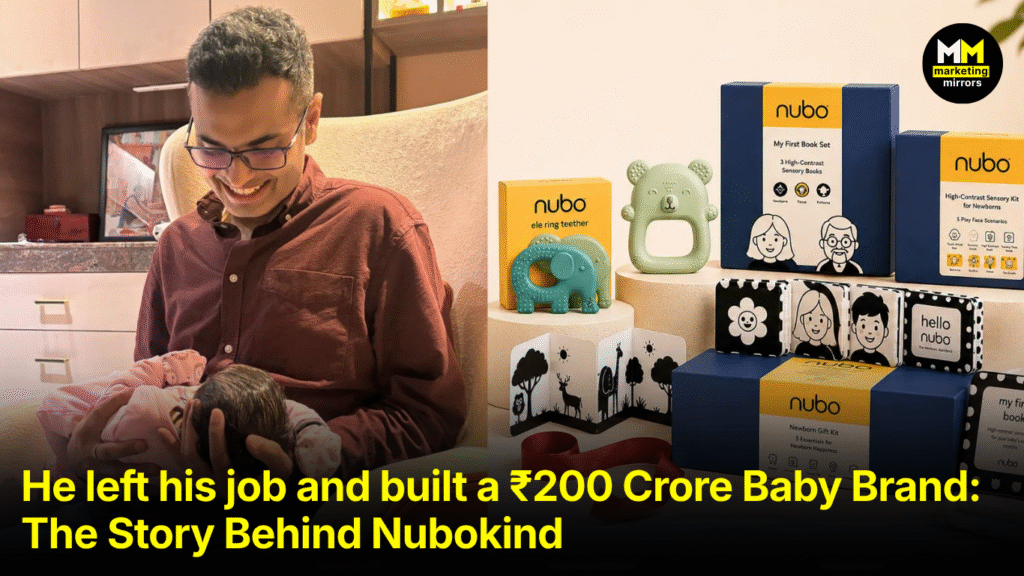
For Aditya Chopra, that problem emerged after returning to India and looking more closely at the products used by babies. Instead of simply accepting the market as it was, he began questioning the heavy dependence on plastic in everyday baby products.
That curiosity eventually led to the creation of Nubokind, a baby-products company focused on creating thoughtfully designed alternatives using materials such as food-grade silicone and fabric.
The company, launched in 2025, started with just two teething products. Since then, it has reportedly received more than 20,000 orders across 700+ cities and has set an ambitious goal of reaching ₹200 crore in revenue within four years.
But the interesting part of Nubokind’s story isn’t just the number.
It is the journey that came before it.
Who is Aditya Chopra?
Aditya Chopra’s career has taken several different turns before he became an entrepreneur in the baby-products space.
He studied engineering and later pursued a master’s degree at the University of Oxford. His professional journey included working with organisations such as Trefis and Samagra, where he eventually held a senior leadership position.
According to his own account, he was earning an eight-figure annual salary before deciding to pursue entrepreneurship.
Rather than immediately building Nubokind, Chopra first experimented with another business.
He launched a rugs business that reportedly reached more than $10,000 in monthly sales within a few months.
Yet, despite building a business that was showing traction, he eventually decided to shut it down.
That decision created the space for his next venture.
How the Idea for Nubokind Started
After returning to India, Chopra began paying closer attention to the products available for babies.
One thing stood out to him: many everyday baby products relied heavily on plastic.
This led him to research materials used in baby products and the concerns surrounding exposure to microplastics and potentially unsuitable materials.
The research pushed him toward a broader question:
Could baby products be designed with safer materials and a more thoughtful approach from the beginning?
That became the foundation for Nubokind.
Instead of trying to create hundreds of products immediately, the company started with a small selection and focused on product design, materials, safety standards and early customer feedback.
Nubokind Started With Just Two Products
Nubokind officially entered the market in July 2025.
Its initial product range consisted of two silicone teethers designed for babies.
The company positioned these products around a few key ideas:
- Food-grade silicone
- BPA-free materials
- Testing against potentially harmful substances
- BIS certification for its teething products
- Simple and functional designs
- Focus on sensory and developmental needs
The idea was not simply to sell another baby accessory.
Nubokind wanted to build products around what it considered a more intentional approach to early childhood development and safety.
From Teethers to Early-Learning Products
The company has since moved beyond its original two-product lineup.
Its catalogue now includes products such as:
- Silicone teethers
- Sensory toys
- Montessori-inspired learning kits
- High-contrast cloth books
- Developmental flashcards
- Tummy-time products
- Newborn-focused gift sets
This expansion reflects a broader strategy.
Instead of remaining a single-category teether company, Nubokind is attempting to build a wider ecosystem of products for babies and young children.
The company also emphasises Montessori principles and sensory development in several of its products.
The Early Traction Behind Nubokind
Despite being a relatively young company, Nubokind has reported significant early traction.
According to the company and founder’s public statements, the brand has crossed:
20,000+ orders
and reached customers in:
700+ cities
The company has also said that a meaningful portion of its sales has come through organic channels such as parent communities, word of mouth and marketplace discovery.
That is particularly interesting for a young consumer brand.
Baby products are a category where trust can play a major role. Parents are often more likely to rely on recommendations from other parents rather than simply purchasing an unfamiliar product because of an advertisement.
For Nubokind, customer recommendations and community-driven discovery could therefore become an important growth engine.
The ₹200 Crore Goal
Nubokind isn’t hiding its ambitions.
The company has set a long-term target of building a business worth ₹200 crore in revenue within four years.
This should be understood as a future target, not the company’s current revenue.
The founder has also spoken publicly about reaching approximately ₹1 crore in monthly revenue as an important milestone on the way toward the larger goal.
The company has reported strong month-on-month growth during its early phase, but maintaining that pace as the business becomes larger will be considerably harder.
Early-stage growth and large-scale growth are two very different beasts. Entrepreneurship, naturally, enjoys giving people increasingly difficult versions of the same problem.
What Makes Nubokind Different?
Nubokind’s positioning revolves around three major ideas.
1. Material Selection
The company focuses heavily on materials used in its products.
Its teethers are positioned around food-grade silicone and are marketed as free from substances such as BPA, PVC and phthalates.
The company also highlights BIS certification for its teething products.
2. Development-Focused Products
Nubokind isn’t focusing solely on physical products designed for immediate use.
Its catalogue also includes learning and sensory products intended to support activities such as visual stimulation, sensory exploration and early learning.
3. Intentional Product Design
The company’s broader philosophy is based on avoiding unnecessary complexity and creating products with a specific developmental or practical purpose.
This is where its Montessori-inspired positioning becomes part of the brand story.
Building the Supply Chain
As Nubokind expands, product development and manufacturing become increasingly important.
Reports about the company indicate that it works with manufacturing partners in Gujarat and Delhi NCR, while certain activities such as quality control, packaging and dispatch are handled through its Faridabad operations.
The company has also worked on proprietary moulds and product designs for some of its products.
Owning more of the product-development process can give a consumer brand greater control over design, quality and differentiation.
Why the Nubokind Story Stands Out
There are thousands of consumer brands competing for attention.
What makes Nubokind’s story interesting is the sequence of decisions behind it.
Aditya Chopra had already experienced a conventional high-paying career.
He had also experimented with entrepreneurship through another business.
Instead of simply continuing along the same path, he chose to start again in a completely different category after identifying a problem he personally found meaningful.
That transition is arguably more interesting than the ₹200 crore target itself.
It shows how entrepreneurship can sometimes come from questioning an existing market rather than inventing an entirely new one.