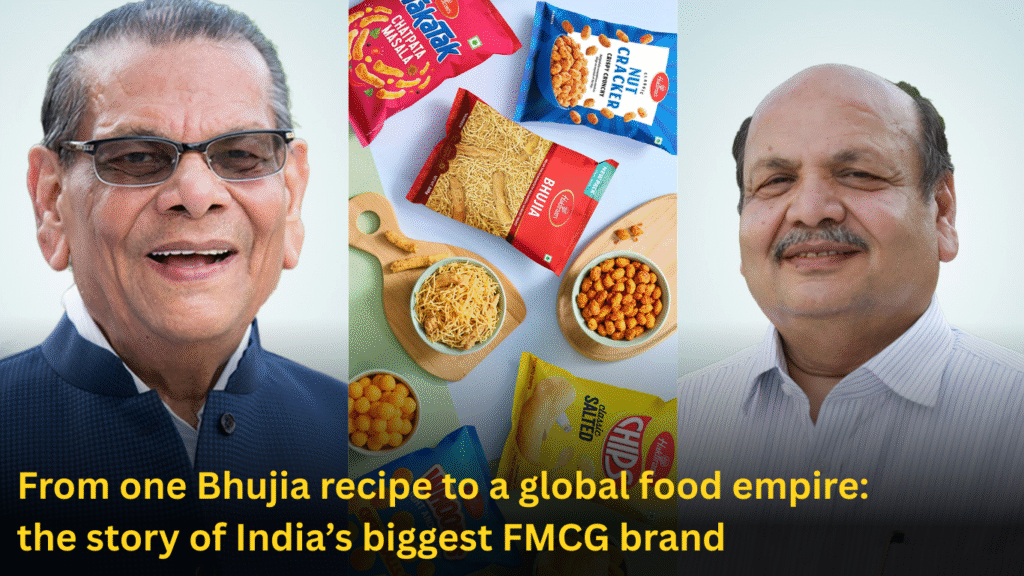
When people talk about India’s biggest FMCG success stories, they often credit heavy advertising, celebrity endorsements, or deep-pocketed investors. Haldiram’s quietly breaks all those assumptions.
What started in 1937 as a small bhujia shop in Bikaner has grown into one of India’s most trusted food brands, with a presence in over 80 countries and revenues crossing ₹10,000 crore. The journey of Haldiram’s is not built on hype. It is built on consistency, quality, and an obsessive focus on taste.
The Humble Beginning in Bikaner (1937)
Haldiram’s was founded by Ganga Bishan Agarwal, also known as Haldiram Ji, in Bikaner, Rajasthan. At the time, Bikaner was already known for bhujia, but the product lacked standardisation.
Ganga Bishan refined the traditional Bikaneri bhujia recipe. He made it thinner, crispier, and more consistent in taste. This small improvement made a big difference. Customers noticed the quality and kept coming back, not because of branding, but because the product delivered every single time.
That consistency became the foundation of the brand.
Quality Over Marketing
Unlike many modern FMCG brands, Haldiram’s did not rely on aggressive advertising in its early years. There were no celebrity endorsements or nationwide TV campaigns driving demand.
Instead, the brand grew through:
- Word of mouth
- Repeat customers
- Trust built over decades
People bought Haldiram’s because they trusted the taste. The product became the brand.
Smart and Logical Expansion
Haldiram’s expansion followed demand, not hype.
Phase 1: Regional Growth
The brand first expanded from Bikaner to Kolkata, then to Nagpur and Delhi. Each location was chosen strategically based on market potential and distribution feasibility.
Phase 2: Product Diversification
What began with bhujia gradually expanded into:
- Namkeens
- Traditional Indian sweets
- Ready-to-eat meals
- Frozen foods
- Bakery products
Each new category followed the same rule: match or exceed the quality customers already trusted.
Phase 3: Global Expansion
Today, Haldiram’s products are available in more than 80 countries, including the US, UK, Middle East, Southeast Asia, and Australia. The brand became a global ambassador of Indian snacks without losing its Indian identity.
Family Business, Professional Systems
Despite being a family-run business, Haldiram’s invested early in:
- Manufacturing automation
- Quality control systems
- Supply chain efficiency
- Scalable packaging and logistics
This balance between traditional values and modern operations helped the company scale without compromising taste.
Why Haldiram’s Strategy Still Works
The success of Haldiram’s is not accidental. Its strategy is built on fundamentals that remain relevant even in today’s hyper-competitive FMCG market. Here are the key lessons modern brands can learn, explained simply and practically.
- Product quality is the strongest marketing tool
Haldiram’s focused on perfecting taste, texture, and consistency long before branding became fashionable. Customers returned because the product never disappointed. When quality stays constant, customers become your advertisers. - Consistency builds trust faster than advertising
While competitors spent heavily on promotions, Haldiram’s invested in processes that ensured the same taste across cities and decades. This reliability created long-term trust, which no short-term ad campaign can replace. - Expansion should follow demand, not trends
Haldiram’s did not rush into new markets or categories. It expanded only where demand already existed, reducing risk and improving profitability. Every new product or city was a logical extension, not an experiment. - Strong fundamentals beat short-term hype
Instead of chasing viral trends or seasonal spikes, the brand focused on supply chain efficiency, cost control, and scalable manufacturing. This allowed Haldiram’s to grow steadily while many flashy brands faded. - A brand is built in kitchens, not boardrooms
Product innovation at Haldiram’s starts with food, not presentations. Recipes are refined based on taste and consumer feedback, not marketing slides. The result is authenticity, something customers can sense immediately.
Revenue Insights and Financial Scale
Haldiram’s today operates as one of India’s largest privately held food companies, with estimated annual revenues between ₹10,000 and ₹14,500 crore.
Key revenue drivers include:
- Packaged snacks and namkeens (largest contributor)
- Traditional Indian sweets
- Ready-to-eat and frozen food products
- Quick-service restaurants and retail outlets
- International exports across 80+ countries
Unlike many FMCG companies, Haldiram’s maintains strong margins by controlling manufacturing, distribution, and branding in-house rather than relying heavily on third-party advertising agencies.
Haldiram’s Business Model Explained Simply
Haldiram’s follows a hybrid business model that combines manufacturing, retail, and exports.
1. Vertically Integrated Manufacturing
The company owns and operates its production facilities. This gives Haldiram’s control over quality, costs, and supply chain efficiency, reducing dependency on external vendors.
2. Strong Distribution Network
Haldiram’s products are available across:
- Local kirana stores
- Supermarkets
- Airports and highways
- Company-owned outlets
- International retail chains
This wide distribution ensures volume-driven growth with minimal marketing spend.
3. Product-Led Branding
Instead of pushing aggressive branding, Haldiram’s lets products drive recall. Packaging is simple, recognisable, and functional. The focus remains on shelf visibility and familiarity.
4. Global Indian Taste Strategy
Internationally, Haldiram’s targets Indian diaspora first, then expands to local consumers curious about Indian snacks. This reduces entry risk in foreign markets.
About Marketing Mirrors
Marketing Mirrors is a storytelling platform that highlights the journeys of brands, entrepreneurs, and creators reshaping the business world. Through inspiring narratives, it celebrates innovation, authenticity, and the power of marketing in driving real success.