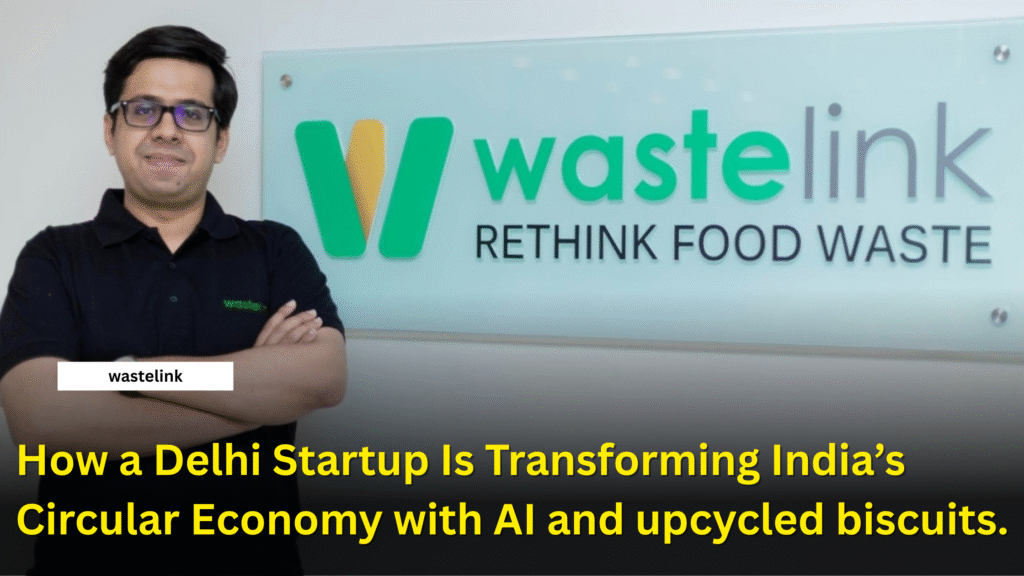
India faces a massive paradox. On one side, millions of tonnes of food go to waste every year because of packaging errors, misprints, or unsold stock. On the other, livestock farmers struggle with rising feed costs. Wastelink, a Delhi-based startup, is solving both problems with one smart idea: upcycling surplus food into nutritious livestock feed. By combining sustainability with artificial intelligence, Wastelink is creating real impact and proving that waste can fuel growth.
The Founding Vision
Wastelink was founded in 2018 by Saket Dave and Krishnan Kasturirangan, later joined by Jaggi Nadig. Together, they built the company on the belief that waste should be seen as a resource, not a burden. Their mission was clear: design a system that not only reduces landfill waste but also provides farmers with affordable feed alternatives. Over time, this vision evolved into their flagship product, ECOMIX — an upcycled feed ingredient made from surplus packaged food.
Business Model: Turning Waste into Value
At the heart of Wastelink’s business model is a B2B supply chain. The company partners with Fast moving consumer goods(FMCG) brands and food manufacturers to collect rejected or expired products. These items are then transported to Wastelink’s processing plants, where they are carefully sorted, cleaned, and converted into ECOMIX. The finished product is sold directly to livestock feed manufacturers, who mix it into their formulations for cattle, poultry, and other animals.
This circular approach benefits every stakeholder: FMCG companies reduce disposal costs and improve their sustainability metrics, feed manufacturers access a new, cost-effective ingredient, farmers get more affordable feed, and the environment is spared from additional landfill waste. It’s a rare model where impact and profit go hand in hand.
Growth and Expansion
In just a few years, Wastelink has grown from a small upcycling experiment to a national operation. The company has established facilities in Sonipat, Lucknow, Mumbai, and Bengaluru, enabling it to process food waste across different regions. Today, Wastelink has upcycled more than 35,000 tonnes of food, supplied feed across 5,000+ pincodes, and helped feed over 38,500 animals every year.
The growth is not just operational. Wastelink has also attracted strong investor interest. With its recent ₹27 crore Series A funding, the startup has now raised a total of ₹47 crore. These funds are being used to strengthen its AI-driven supply chain, expand product lines, and prepare for international exports.
Revenue and Market Potential
Wastelink’s revenue model is straightforward: it earns by selling ECOMIX to feed manufacturers. With livestock farming growing rapidly in India, demand for affordable and sustainable feed is rising. While exact revenue figures are not public, industry reports suggest the company has crossed significant annual sales milestones and is scaling at a steady pace.Globally, the upcycled feed ingredients market is expected to touch nearly $120 billion by 2034, and Wastelink is positioning itself to capture a slice of that market. By diversifying its formulations for different animals and expanding to rural hubs, it is building multiple revenue streams that balance growth with long-term sustainability.
The Role of AI and Technology
Unlike traditional waste handlers, Wastelink relies heavily on AI to run its operations. Its reverse supply chain tracking system ensures complete traceability, giving FMCG partners confidence in how their surplus is managed and providing feed makers with reliable quality data. This technology-first approach has been a key driver of Wastelink’s business growth, helping it scale efficiently while maintaining trust across stakeholders.
Why Wastelink Matters
In India, nearly one-third of all food produced goes to waste, even as farmers face high input costs. Wastelink’s model bridges this gap by converting wasted food into valuable livestock nutrition. Beyond saving costs, the company is tackling climate change by reducing landfill waste and lowering carbon emissions. It’s an approach that shows how sustainability and profitability can reinforce each other.
Looking Ahead
The future looks promising for Wastelink. With fresh funding, the startup is planning to expand deeper into rural India, build specialized feed formulations, and tap into global export markets. Its long-term ambition is to become a leader in AI-enabled circular economy solutions, where waste is not just managed but transformed into opportunities for growth.
Marketing Mirror — Reflecting Stories of Growth
At Marketing Mirror, we take pride in highlighting stories like Wastelink’s — stories where innovation, sustainability, and business success come together. Our team of content strategists and SEO specialists works to simplify complex ideas, craft powerful narratives, and make sure they reach the right audience. By telling these stories, we aim to inspire entrepreneurs, marketers, and leaders to think differently. Wastelink’s journey from surplus biscuits to a revenue-generating, sustainability-driven business is exactly the kind of growth story Marketing Mirror exists to share.